• Doing Good Without God? Huh?


    “In those days there was no king in Israel; every man did what was right in his own eyes.” (Judges 17:6 NASB)

    “And the King will answer them, ‘Truly, I say to you, as you did it to one of the least of these my brothers, you did it to me.’ (Matthew 25:40 ESV)

    THE STORY GOES THAT Benjamin Franklin created his own non-doctrinaire guide to “good works” that emphasized the virtues associated with the Christian faith’s walk with Christ but eliminated the role of God as the source.

    The idea behind this, no doubt, was the rationalist’s view that most moral  platitudes — the variety of “dos” and “don’ts” — are self-evident and that ascribing their origin to an unseen Diety — holy, perfect, and judgmental —was both unnecessary and unwise!RulesYouCanYouCan't.gif

    After all, the rationalist would argue, if the ideas were generated by some source superior to oneself, there’s no telling what additional platitudes might be lurking behind the ones we’ve identified.

    Once that happens, well, look out because we might not want any of THOSE platitudes. Nope. We want complete control over the list. This will be our list, not one handed to us by an outside source.

    +++

    OKAY, SO WHAT WAS on the list that Mr. Franklin compiled and what was his point in compiling the list in the first place? (more…)

  • Stepping Out In Faith: LoveAndGrace 2017


    When the priests who were carrying the chest came to the Jordan (River), their feet touched the edge of the water. The Jordan had overflowed its banks completely, the way it does during the entire harvest season. But at that moment the water of the Jordan coming downstream stood still. (Joshua 3:14-16a CEB)

    “But may those who love the Lord be like the sun when it rises in all its brightness.” (Judges 5:31 GW)

    SOMETIMES, THE LORD ASKS US TO STEP OUT IN FAITH.

    This blog is one of them. At the start of 2016, I began to write and publish a Christian-themed blog, which I believe the Lord has equipped me and led me to write.

    LoveAndGrace was not to be a testament to my thoughts or experiences or dreams but a willing vessel for the ideas that I felt the Lord giving me to share. I’m taking seriously the biblical testimony that each of us is called to witness to those whom we are uniquely suited to reach. So, if Billy Graham reaches 50 million people, and I reach 5 people, my 5 people are added to his 50 million people–that’s 50 million +5 who will enjoy eternal life with the Creator. (more…)

  • Avoiding All Those Arguments


    It is honorable for a man to resolve a dispute, but any fool can get himself into a quarrel. (Proverbs 20:3 HCSB)

    A gentle answer turns away wrath, But a harsh word stirs up anger. (Proverbs 15:1 NASB)

    WHY DO WE ARGUE?

    People argue. We know that. God knows that. That’s why He put so many verses in the Bible reminding us to be slow to anger and quick to forgive. He tells us that in our anger, we should not sin nor should we let the sun set while we are still angry (Ephesians 4:26 NIV).

    To make it clear to us, He tells us that he is a loving God and that He models what He wants us to do: “But you are a forgiving God, gracious and compassionate, slow to anger and abounding in love” (Nehemiah 9:17 NIV).

    menarguingatworkWe know what the antidote to anger is. It is love. In one of the most poetic chapters of the Bible (1 Corinthians 13), the apostle Paul reminds us that among love’s many attributes is this one: love “is not easily angered” (v. 5 NIV).

    We get angry as a tool to get our way in a broken world, and so we lash out at the people who stand in our way, you know, the ones standing right there in front of us who express their needs — legitimate needs — that conflict with our needs.

    Here’s the dilemma: Those people who most often stand in our way are the ones we are with the most … and the ones we are with the most are the ones we love the most. (more…)

  • Trusting in the Lord’s Promises


    So we fix our eyes not on what is seen, but on what is unseen, since what is seen is temporary, but what is unseen is eternal. (2 Corinthians 4:18 NIV)

    Let us hold unswervingly to the hope we profess, for he who promised is faithful. (Hebrews 10:23 NIV)

    THIS MEDITATION HITS HOME.

    Like many people who reach adulthood before accepting Jesus’ love and grace into their hearts, I responded to the Master’s promise of what He could do for me — that He would provide rest for my troubled soul and  eternal life with Him in Paradise.

    FlowerSproutingInWood.jpegI did not “sign up” for the rest of it — spiritual warfare, condemnation from loved ones, or conviction for sinful thoughts and behavior. In other words, I wanted what Jesus could do for me, without thinking I would be called on to do anything in return.

    Oh, yes, I assumed I would be made more aware of other people’s hurts and needs and maybe asked to do something about it, you know, from time to time. Nothing really inconvenient and probably nothing right away.

    I had no idea. (more…)

  • Keep Your Faith Out of My Face!


    “You will receive power when the Holy spirit comes on you and you will be my witnesses … to the ends of the earth.” (Acts 1:8 NIV)

    THERE ONCE WAS A MAN who was a new convert to Christ and His teaching. This man held a job where he had been employed for 20 years. Once he became a Christian, the Lord started doing some housework in his heart, sweeping out the dust and cobwebs, discarding the trash, and washing the windows.

    Each morning the man came to work with a smile and a greeting for everyone — even on Mondays! He noticed the contributions his co-workers made and dropped compliments their way, focusing on work-related items and carefully avoided personal areas, like appearances, for example. (more…)

  • Depending on God for Our Sanity


    It is good for me that I was afflicted, that I might learn your statues. (Psalm 119:71 ESV)

    HOW MANY OF US who have become Christians, who have asked Jesus Christ to come into our lives as our Savior, have done so looking to suffer for that decision?

    Most of rejoice-in-your-sufferingus probably have resonated to Jesus’ promise in Matt. 11:28-30, which starts with these words: “Come to Me, all you who are weary and burdened, and I will give you rest” and ends with these: “For My yoke is easy and My burden is light” (BSB).

    When it came to that moment when we raised our hands and marched down the aisle, or dropped to our knees and raised our faces to the ceiling, or even placed our foreheads to the ground in agony, most of us were not thinking of Ephesians 6:10-13, which includes these stirring words: “For our struggle is not against flesh and blood, but against the rulers, against the authorities, against the powers of this dark world and against the spiritual forces of evil in the heavenly realms” (v. 12, NIV).

    Nor were we likely thinking of James 1:2-4 (NIV), “Consider it pure joy, my brothers and sisters, whenever you face trials of many kinds, because you know that the testing of your faith produces perseverance. Let perseverance finish its work so that you may be mature and complete, not lacking anything.”

    +++

    WHAT, THEN, ARE WE TO MAKE of Bible verses that clearly foretell of suffering in this world as a result of our conversion? (more…)

  • Jesus and the Two Blind Men


    Two blind men were sitting by the road. Hearing that Jesus was passing by, they cried out, “Lord, Son of David, have mercy on us!” The crowd following Jesus sternly told them to be quiet, but they cried out all the more. Jesus stopped and said, “What do you want Me to do for you?” “Lord,” they said, “we want our eyes to be opened.” Moved with compassion, Jesus touched their eyes. Immediately, the men regained their sight and followed Him. (Matthew 20:29-34 NIV, edited)

    IF EVER THERE WERE a Bible story that pointed out what’s wrong with the church and its mission outreach, this is it.

    Here was Jesus walking along a dusty road followed by, what various translations call “a large crowd,” “a great multitude,” “an immense crowd,” — basically, the church at the  time — when they passed by two beggars on the side of the road. The beggars were blind and seeking alms.

    jesus-heals-two-blind-menWhile they could not see the proceedings, they could hear the pounding of sandaled feet, the excited murmur of voices, and the general hubbub associated with the assembly of many people.

    When they heard the commotion was caused because Jesus was present, they reached out to Him for help. “Lord, Son of David,” they called out. The phrase, “Son of David,” was the Jewish phrase for the long expected Messiah, so, in truth, they were acknowledging the Divinity of Jesus.

    And what was the multitude’s response? The Jesus followers. The disciples, groupies, hangers on, and wannabes. You know, the church!

    They told the blind men to “shush,” that they were a bother. Jesus’ followers (the church, at the time) was too busy following Jesus to pay attention to human suffering along the roadside.

    +++

    AHHH, BUT NOT JESUS.

    He wasn’t too busy. He heard their cries for help. He stopped the action and called them over, and then, to check their faith, He asked what they wanted Him to do for them. Imagine that — the Son of God asking His creation what He could do for them. (more…)

  • Fearing to Trust: Do We Miss God’s Open Doors?


    And they came to Jesus and saw the demon-possessed man, the one who had had the legion, sitting there, clothed and in his right mind, and they were afraid. (Mark 5:15 ESV)

    And they began to beg Jesus to depart from their region. (Mark 5:17 ESV)

    THE LORD PROMISES GOOD THINGS for us — hope and a future — if we would trust Him, but so often, we shrink back into the familiar, afraid to take the next step.

    What holds us back?

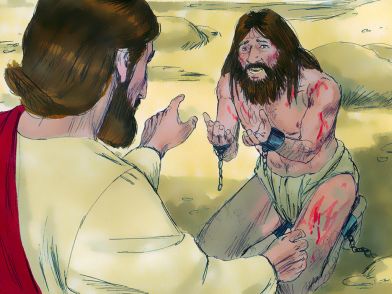
    The synoptic Gospels (Matthew, Mark, and Luke) describe an encounter Jesus had with demons in the area of the Gerasenes region, where He dispatched a legion of evil spirits from torturing the town madman and sent them into a nearby herd of 2,000 pigs, who rushed down a steep bank and were drowned. 

    The outraged and frightened herdsmen ran to tell the townspeople what had just happened (“ComWoman Sharing With Womane quick!” they might have said. “You won’t believe this! You know that deranged dude? And the pigs? Well, you’ll just have to see this.”), and the townspeople immediately ran to the side of the lake where Jesus was teaching His disciples. Once they arrived, they begged the Lord to leave.

    What?!

    +++

    AS WE READ THE ACCOUNT, safe and comfortable in our armchairs, most of us cannot imagine how the townspeople could have begged Jesus Christ, the Son of the Creator, to leave their village, when He had just demonstrated God’s amazing grace by healing the town madman. (more…)

  • Demons and Disciples: Two Responses to Jesus


    The disciples were amazed. ‘Who is this man?’ they asked. ‘Even the winds and waves obey him!’” (Matthew 8:27 NLT)

    “And (the demons) cried out, saying, ‘What business do we have with each other, Son of God? Have You come here to torment us before the time?’” (Matthew 8:29 NIV)

    TWO VERSES APART. TWO SEPARATE RESPONSES.

    In Matthew’s account of Jesus Christ’s earthly ministry, two radically different responses to the man Jesus were presented a mere two verses apart.

    In the first case, His disciples — that is, followers of Jesus himself — expressed amazement that Jesus could be awakened during a storm and, 

    Two Responses to Jesus - Winds
    Jesus calms the raging sea.

    with a single word, stop a storm that threatened their small boat. They wondered who He was!

    In the second case, evil demons — that is, followers of Satan — cried out in anguish that Jesus, whom they knew as the Son of Almighty God, had come to send them to eternal punishment before their allotted time. They were inhabiting a man who lived among the tombs and, knowing Jesus would heal the man, begged Him to send them to a nearby herd of pigs.

    How strange that those who knew Jesus were following the wrong guy and those who one day would shape the world for His Kingdom still hadn’t caught on that this was God’s Son.

    True enough, the disciples knew Jesus was special. After all, they had obeyed His call to follow Him and had seen Him feed 5,000 men (and many more women and children) from a few loaves of bread and a couple of fish. Top that off when, in a desperate panic, they had just awakened Him from a sound sleep to tell them their boat was taking on water in a sudden storm.

    Jesus-heals-troubled-man
    Jesus heals a troubled man.

    Even so, they weren’t quite sure what to make of it all.

    The demons knew. James, a half-brother to Jesus, assures us in his New Testament letter that “the demons believe … and shudder” (James 2:19 NIV). So, the point is made that, at least with Jesus Christ, seeing is not the same as believing.

    +++

    AT FIRST GLANCE, it would seem that the demons were more in tune with the Creator of the universe than the apostles were, even though the twelve men watched the Lord daily heal the physically and mentally ill and teach with authority in the various synagogues. (more…)

  • Stop Being Angry: What Purpose Does It Serve?


    “Stop being angry! Turn from your rage! Do not lose your temper—it only leads to harm.” Psalm 37:8 (NLT)

    “He who is slow to anger has great understanding, but he who is quick-temperated exalts folly.” Proverbs 14:29 (NASB)

    “Let all bitterness and wrath and anger and clamor and slander be put away from you, along with all malice.” Ephesians 4:31 (ESV)

    “In your anger do not sin: Do not let the sun go down while you are still angry.” Ephesians 4:26 (NIV)

    WHAT GOOD PURPOSE DOES ANGER SERVE? The Bible is filled with admonition against human anger, while it promotes God’s righteous wrath.

    So, what’s the difference? Why is it okay for Almighty God to be angry, but not us? Perhaps the key is not who is getting angry but why the person is angry.

    Let’s take a look at God’s anger.

    Theologian J.I. Packer says that God’s anger, as described in His Word, “is never the capricious, self-indulgent, irritable, God's Righteous Angermorally ignoble thing” that often marks human anger but “a right and necessary reaction to objective moral evil.”

    God hates human sin. He gave us His commandments to steer us in the right direction. The first four tell us to love and honor God; the remainder tell us to love and honor one another. He gets angry — and rightly so — when we fail to do that. (more…)