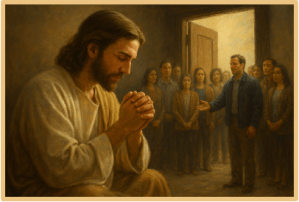
“Behold, I stand at the door and knock. If anyone hears my voice and opens the door, I will come in to him and eat with him, and he with me.” Revelation 3:20 ESV
“I do not ask for these only, but also for those who will believe in me through their word.” John 17:20 ESV
“Jesus said to him, “Have you believed because you have seen me? Blessed are those who have not seen and yet have believed. “” John 20:29 ESV
A CHRISTIAN MESSAGE
By WARD PIMLEY
Pastor, Journalist, Author
SUMMARY
TOGETHER, THOSE VERSES reveal a glorious pattern: Christ prays for future believers, His word reaches us, He beckons us and waits patiently for us to answer, and those of us who trust Him–even without having seen Him physically–live in communion with Him.
COMMENTARY
In Revelation 3:20, Jesus is addressing the faithless church in Laodicea, the apostate church. He is holding out hope for them, for just as He did with the woman caught in adultery, He is more interested in saving souls than He is in condemning people or even rebuking them.
He says, “I offer Myself to you. I will not force Myself on you but will graciously extend My hand. If you will hear my voice, see My hand, recognize My offer, and accept My gift, I will not turn you down.” He tells us He’ll come in–gladly, warmly, openly–and eat with us. We’ll become friends. However, He remains more than a friend: He also is our Lord (leader) and Saviour (ransom).
This is more than a salvation from judgment, which is the absence of a negative; this is an offer of friendship, which is the presence of a positive.
When this promise is married to that of John 17:20, in His High Priestly Prayer, He is extending that same offer of friendship to those of us who were born 2,000 years later, who did not have the privilege of seeing the Man Jesus in His earthly walk, but who knew Him only through the words of those who had seen Him.
We see something else: The Godhead is willing–eager, even–to work salvation through the words and deeds of mere humans, of us. Fortunately, our forebears carried the mantel. Now, we must pick it up and carry it forward for others.
We see that even in the Messiah’s agony, He is thinking about us and praying for us to the Father. When was the last time any of us prayed for someone 2,000 years from now while we were facing a personal agony, a trial, or a tribulation? I know I haven’t.
Remember the words of the Great Commission in Matthew 28:18-20 (also Acts 1:8; Mark 16:15)–Go and tell the Gospel to every creature–to everyone! I am with you!
Finally, in John 20:29, when He faces the disbelief–and then the honorific of Thomas, “my Lord and my God!”–He says it is a blessing for Thomas to believe because he has seen but even more blessed will it be for those of us who believe without having seen.
CONCLUSION
While we have not seen Him in the flesh, as did our forebears, we do see Him today through the Holy Spirit. Faith, born through apostolic testimony, becomes the door opened to the unseen Saviour.
MESSAGE FOR ME
JESUS IS CALLING ME to do for others what He has done for me, and what He has commissioned those who walked with Him to do for those who would come after them.[Jesus does not just call pastors and theologians to carry the Word but all believers. We need to be partners or co-workers in the harvest field.].
Since I am living proof of the work that has gone before me, I have no excuse for not carrying the mantel forward. The good news for me is this: Jesus promises to go with me. He says, “Lo, I am with you, even to the close of the age.”
I presume that’s forever, but it could mean the end of the Church Age (the Rapture). Either way, He has promised not to leave us as orphans but through the Holy Spirit, to live in our hearts. He is there to guide us, to comfort us, to console us, to encourage us, to teach us, and to share time with us. He also is there to remind us that He advocates for us to the Father.
PRAYER
HEAVENLY FATHER, Lord God, Creator of the Universe – Accept our worship, our praise, and our adoration. You alone, O God, are worthy; You alone, O God, are good. You have called us to be Your friends, while You died to ransom our souls and stand patiently outside the door, knocking, and waiting for us to hear Your voice and open the door. Lord, forgive us for our faithlessness, our wanderings, our disrespect, our disobedience, our willfulness. When I think of my sins, I am ashamed. I ask you, humbly and, if only mentally and in my heart, on my knees before You: Please grant me Your mercy and Your grace, and empower me, O Lord, to extend mercy and grace to others. In the mighty name of Jesus, the Messiah. AMEN
In the beginning was the Word, and the Word was with God, and the Word was God. He was in the beginning with God.All things were made through Him, and without Him nothing was made that was made. In Him was life, and the life was the light of men.And the light shines in the darkness, and the darkness did not comprehend it. – John 1:1-5 NKJV
ALMIGHTY GOD – We thank you for this opportunity to gather in worship of You and to praise Your mighty name. Thank You for how You have blessed us. We pray that this message will be Your message, that it will reflect Your truth, and that we will be guided and encouraged in our fellowship with You. In Jesus’ name we lift this prayer.AMEN
MESSAGE
WE COME TO an interesting question/answer segment in our current series, this one regarding the *Christian Disciplines*, a term that refers to customs and practices faithful Christians follow to stay close to the Lord.
This is the third item in our series.
You’ll recall in our first item, “I Am a New Christian. Now What?”, we had identified five characteristics of the born-again Christ: Rejuvenation (spiritually alive), Redeemed (bought with a price), Justified (declared debt-free), Adopted (part of God’s family), and United With Christ (becoming one with the Son).
In our second item, “Which Version of the Bible Should I Read, we discussed the pros and cons of word-for-word translations as well as thought-for-thought and paraphrase, and concluded that a dedicated Bible reader would want to (1) find a comfortable version to read and (2) might want to read side-by-side translations.
In this lesson, we’ll see that the Christian Disciplines are designed to help us: Abide in Jesus and Draw Near to Jesus.
Jesus told us to abide in Him, and He would abide in us.
[Interesting, at least to me, is that those encouragements came from half-brothers: Jesus told us to abide in Him (John 15), and his half-brother James urged us to draw near to Him (James 4).]
There are six disciplines we’re going to discuss, but we’ll focus mainly on the first three of them: Bible reading, prayer, and meditation; the other three are fasting, tithing, and serving (time and treasure).
Staying connected to the Holy Spirit is critical to keeping us on track during our earthly journey.
When we pull away from God or are slack about staying on the “straight and narrow” path (see Matthew 7:13-14), we’ll lose God’s …
spiritual input,
energy,
guidance, and
direction.
We have a word for that: It’s called *Lost*.
The world tries to pull us away from our spiritual grounding and provides all sorts of enticing diversions, including daydreaming, under the guise of meditation.
The apostle Paul (Romans 12) reminds us not to be “conformed to this world” but to be “transformed by the renewal of [our] minds” so we will know what is the “good, and perfect, and acceptable” will of God.
THE DISCIPLINES
BIBLE READING
All Scripture is given by inspiration of God, and is profitable for doctrine, for reproof, for correction, for instruction in righteousness. – 2 Timothy 3:16 NKJV
For prophecy never came by the will of man, but holy men of God spoke as they were moved by the Holy Spirit. – 2 Peter 1:21 NKJV
YOUR WALK WITH CHRIST SHOULD LEAD YOU TO LOVE READING HIS WORD and to consider the time you spend alone with the Lord to be the highlight of your day.
This is not a duty to be performed before you get on with the real work of your life.
You’ll may find as you start having difficulty carving out even five minutes for morning devotions. Pray that God will carve the time out for you. Soon, you’ll be spending more time and finding it more valuable.
As for which version or translation to read, that depends on your walk. Some people like to stay with one translation; others want to learn the Word from several translations.
You’ll find some translations (NASB, NKJV, ESV) are word-for-word translations, whereas others (NIV, NLT, NET, NCV, GNT) are thought-for-thought.
The WFW Bibles are truer to the original script in writing; the TFT Bibles are easier to read and understand. One technique people use is to read side-by-side versions.
In the end, you need to find what’s comfortable for you, and don’t be surprised if you switch around as you grow.
PRAYING
Very early in the morning, while it was still dark, Jesus got up, left the house and went off to a solitary place, where he prayed. – Mark 1:35 NIV
But you, when you pray, go into your inner room, close your door and pray to your Father who is in secret, and your Father who sees what is done in secret will reward you. – Matthew 6:6 NASB
PRAYER IS A TREMENDOUS PRIVILEGE. We ought to want to treat this as the incredible, and so undeserved, privilege it is; yet so many of us have stale prayer lives or nonexistent prayer lives.
We treat prayer as an obligation and think we’re good if we recite a memorized prayer from our past.
Can you imagine having a conversation with a family member or a good friend who just rattles off memorized comments to you?
“Hi! How are you? I like your blouse (shirt). Isn’t it hot out today? Where are you going now? Okay, goodbye.”
Next day: “Hi! How are you? I like your blouse (shirt). … Okay, goodbye.”
A few days later, we see that person again, and he/she says: “Hi! How are you? I like your blouse (shirt). … Okay, goodbye.”
The Creator of the universe allows sinful man to pray to Him! To talk with Him, ask Him questions, petition Him, seek forgiveness, offer praise, express frustration, and express anger — anything in Jesus’ name!
You don’t need an appointment, you can discuss any topic, and you can stay as long as you want! What other CEO allows you such unfettered access … and loves hearing from you?
This is not a ritual, with ritual words, flung rapidly into the air. Instead, this is thoughtful, heartfelt dialogue within the spiritual realm.
Pray to your Father in secret, and He will hear your prayer.
Jesus said God is spirit, and we are to worship Him in spirit and in truth (John 4:24). Let your prayers be the highlight of your day.
Oh, by the way, Paul urged us to pray constantly, so you can pray – in some way – all through the day, feeling nourished and strengthened by His love. (1 Thessalonians 5:17; Romans 12:12)
Practice using “prayer-lets” – little prayers, like, “God, help me please.” “Thank You, Lord.” “Forgive me, Father.” “Help me find my car keys (wallet, phone).”
You might like an encouraging prayer, like “Bless me, Lord, to be a blessing to others” or “Plan to do the Lord’s work; Work to do the Lord’s plan.”
You also could recite from Galatians 5:22-23 the nine components of the Fruit of the Spirit: “Love, joy, peace, patience, kindness, goodness, faithfulness, gentleness, and self-control.” At least one of them will be helpful in whatever situation you find yourself.
MEDITATING
Blessed is the man who walks not in the counsel of the wicked, nor stands in the way of sinners, nor sits in the seat of scoffers; but his delight is in the law of the LORD, and on his law, he meditates day and night. – Psalms 1:1-2 ESV
May these words of my mouth and this meditation of my heart be pleasing in your sight, LORD, my Rock and my Redeemer. – Psalms 19:14 NIV
Finally, brothers, whatever is true, whatever is honorable, whatever is right, whatever is pure, whatever is lovely, whatever is admirable—if anything is excellent or praiseworthy—think on these things. – Philippians 4:8 BSB
MEDITATION IS AN *UNDERUTILIZD DISCIPLINE* – misunderstood and often neglected.
This is not Eastern-style meditation, which consists of emptying the mind and repeating *hums* to block out intrusive thoughts.
Rather, this is a Scripture-based meditation, which is “thinking on these things.”
Reflecting on the morning’s Scripture reading.
Cultivating stillness to listen for God’s voice.
Praying for insight into private experiences.
Looking to reflect Christ’s love and grace in difficult moments.
Meditation plays a role in prayer and study.
What do we need to pray about?
What questions should we be asking?
What are the relevant/meaningful passages?
Who do we need to reach?
FASTING
And when you fast, do not look gloomy like the hypocrites, for they disfigure their faces that their fasting may be seen by others. Truly, I say to you, they have received their reward. – Matthew 6:16 ESV
“Yet even now,” declares the LORD, “return to Me with all your heart, with fasting, weeping, and mourning.” – Joel 2:12 BSB
WAY UNDERDONE. YOU MIGHT RARELY HEAR OF ANYONE FASTING. Some will fast for a meal, such as skipping lunch. Others will fast solid food for a day but take plenty of liquid. Others will cut back on food consumption (desserts) for three days.
The point is that your cravings for food will grow, and you’ll need to depend on God’s strength and lovingkindness to make it through the fast. Fasting is designed to build your reliance on God.
Fasting can take other forms: social media, television, dessert, soda, sugar, second helpings.
Many Christians, Bible-based, strong-in-the-faith Christians rarely, if ever, fast. You might want to pray about God’s direction for your life, to see what He wants for you. If you fast food and drink, you might want to consider health risks, depending on the extent of your fast.
My approach, instead of denying myself something, is adding something to my devotions. During the fasting period, I will add to my time reading the Bible, add to my time praying, and add to my time in meditation. I will consciously look for additional service opportunities or for another organization to support financially.
My view is that denying myself does little for me and nothing for others I meet; whereas, adding devotions to my life benefits both me and others.
TITHING
“My point is this: The person who sows sparingly will also reap sparingly, and the person who sows generously will also reap generously. Each one of you should give just as he has decided in his heart, not reluctantly or under compulsion, because God loves a cheerful giver.” – 2 Corinthians 9:6-7 NET
“‘Bring the full tenth into the storehouse so that there may be food in my house. Test me in this way,’ says the LORD of Armies. ‘See if I will not open the floodgates of heaven and pour out a blessing for you without measure.’”– Malachi 3:10 CSB
PLEASE DON’T SEE THIS AS THE CHURCH HITTING YOU UP FOR MONEY. Churches are voluntary organizations. They thrive or die on collections.
God was clear that we should give to the church through the thankfulness of our hearts. Prayerfully find a church where you can plug in and support it with your time and treasure.
Consider it all joy that God has called on you to contribute to His Kingdom.
In addition to your giving to the local assembly, you might want to pray about contributions to Christian-based charitable organizations.
SERVING
In the same way, faith by itself is dead if it doesn’t cause you to do any good things. – James 2:17 GNT
I preached that they should repent and turn to God and demonstrate their repentance by their deeds. – Acts 26:29 NIV
Produce fruit worthy of repentance. – Matthew 3:8 BSB
GOD HAS GIFTED EACH OF US DIFFERENTLY TO SERVE HIM IN VARIOUS CAPACITIES (see Romans 12; 1 Corinthians 12).
Some can teach or play musical instruments or sing; others can handle finances or are skilled in painting, carpentry, plumbling, or electrical; others can work with seniors, youth, or in the nursery; while still others make excellent greeters, parking lot attendants, or security detail.
Praising my Savior all day long. Let us raise our voices in song.
We are a mosaic of humans, which God weaves together to form the church.
There is a place for you in His Kingdom building.
Serve humbly; serve joyfully; serve in community.
Remember that Jesus washed His disciples’ feet (see John 13). He said that no student is more important than His teacher (John 13:16).
Jesus’ point is that if He, your Lord, can stoop to wash your dirty feet, surely you can set up tables, serve a meal, teach children, clean bathrooms, greet strangers, or pray with a colleague.
That’s just for starters. Pray about where He wants you. He’ll make it clear to you, if you will listen.
Sometimes, He’ll take you out of your comfort zone, and you’ll need to come under someone else’s authority.
More often, He’ll use the gifts and talents He has given you, augmented by your training, education, and experience, to further His Kingdom.
FINAL WORDS
THE SPIRITUAL DISCIPLINES should not be seen as mere religioius practices, which may give the impression of piety and faithfulness but, in reality, lack any semblance of worship, evangelism, or discipleship.
Instead, they should be seen as God-induced, Bible-supported activities that we can engage in with great enthusiasm to guide, direct, and enhance our walk with Jesus Christ.
We are connecting with God the Father and God the Son through the bonding power of God the Spirit.
Whether you are reading your Bible (or someone is reading it to you, or you are reading it to someone else), or whether you are praying and sharing your heart with your creator, or whether you are “thinking on these things” – meditating, contemplating – you should enter these disciplines with joy and deep anticipation, eager to learn what God wants to share with you.
When you are done, you should feel a closer bond with God the Father and God the Son through the bonding power of God the Spirit.
Keep reading your Bible.
Keep praying.
Keep meditating (thinking on these things).
PRAYER/BENEDICTION
ALMIGHTY GOD, LORD OF CREATION:
Help us, as we go forth, to be mindful of Your presence and Your call on our lives. May we be diligent in following the Christian disciplines so we will remain close to You as faithful disciples and ambassadors for Christ.
NOW, may the Lord bless you and keep you. May the Lord make His face shine on you and be gracious to you. May the Lord turn His face towards you and give you peace, both now and forevermore. AMEN and AMEN
“Come to the Lord, the living stone rejected by people as worthless but chosen by God as valuable.” – 1 PETER 2:4 GNT
“But you are a chosen people, royal priests, a holy nation, a people for God’s own possession. You were chosen to tell about the wonderful acts of God, who called you out of darkness into his wonderful light.” – 1 PETER 2:9 NCV
CHRISTIAN MESSAGE
By WARD PIMLEY
Pastor, Journalist, Author
THE APOSTLE PETER mentions “chosen” three times in our passage: the first time, He references His Son; the next two times, He references us.
>Chosen by God as valuable.
>Chosen to be royal priests/a holy nation.
>Chosen to tell others the Good News.
That word “chosen” is key to understanding 1 Peter 2 because God, through His servant Peter, reminds us that He has “chosen” us.
In fact, in Genesis Chapter 1 Verse 28, God chose us to be collaborators with Him in rendering *dominion* over the fish of the sea, the birds of the heavens, the livestock, and over all the earth, and over every living thing that creeps on the earth.
Genesis 1:27-28 (ESV) So God created man in his own image, in the image of God he created him; male and female he created them. And God blessed them. And God said to them, “Be fruitful and multiply and fill the earth and subdue it, and have dominion over the fish of the sea and over the birds of the heavens and over every living thing that moves on the earth.”
Please keep in mind that as we exegete 1 Peter 2, we can appreciate why God puts up with us, why He has redeemed us through His Son. He has *chosen* us and still *chooses* us to be in partnership with Him and in fellowship with each other.
Keep in mind, also, that in our first text verse, the apostle says that Jesus is the *living stone* chosen by God to be valuable, even though His people rejected their Messiah, even though most people even today reject the Messiah.
That word *chosen* is the key word in 1 Peter 2.
1 Peter 2 verses 1-3 (1st segment)
“So, put away all malice and all deceit and hypocrisy and envy and all slander.” – 1 Peter 2:1 ESV
In your identity as a follower of Jesus Christ, as a true believer that He is the Messiah, the Second Person of the Tripartite Trinity, here are some descriptions – or indicators – of how you should live. This list comes to us from God through Peter. This is God’s list, not Peter’s list. Peter was the instrument, but God was the author.
Rid yourself of:
Malice
Deceit
Hypocrisy
Envy
Slander
Replace them with: Pure Milk of the Word – so, like a baby grows through life into an adult, you may grow in your spiritual life to become one who …
Is a mature Christian,
Draws confidence from his/her walk with the Lord,
Can withstand spiritual conflict (warfare),
Will witness in word and deed for the Lord Jesus Christ, and
Honors Fruit of the Spirit – love, joy, peace, patience, kindness, goodness, faithfulness, gentleness, and self-control.
1 Peter 2 verses 4-8 (2nd segment)
“Come to the Lord, the living stone rejected by people as worthless but chosen by God as valuable.” – 1 Peter 2:4 NCV
Peter then describes believers as “living stones” who are being built – or fashioned by God – into a spiritual house. That house, or structure, features Jesus Christ as the “cornerstone,” the building block upon which the house is built and stands.
What you’ll see as a believer is that much of the world will not respect your beliefs but will consider you to be their enemy: you will be labeled a ‘hater’ or a ‘bigot’ because you believe what God tells us through His Word (the Bible), which differs from what the world teaches.
The world holds “human reason” to be the god of gods; Christians hold God’s Word to be God.
So, we believe …
God when He said He created two genders, not 57 of them.
Men should protect women and provide for them, and, in turn, women should respect men and encourage them for the burden of care God has placed on men.
We should protect the lives of the unborn, considering them human, with separate DNA from their mother, and conceived with God’s blessing.
We should share the peace and joy God has placed on our hearts instead of the rancor, self-centeredness, and striving for material gain that mars the lives of unsurrendered hearts.
You will, by your life and word, prove the world’s lie as to what is true and good and perfect versus what is not.
The Bible tells us not to be conformed to this world, but to be transformed by the renewal of your mind, so that you may prove what is the good and acceptable and perfect will of God. – Romans 12:2 NKJV
1 Peter 2 verses 9-10 (3rd segment)
“But you are a chosen race, a royal priesthood, a holy nation, a people for his own possession, that you may proclaim the excellencies of him who called you out of darkness into his marvelous light. Once you were not a people, but now you are God’s people; once you had not received mercy, but now you have received mercy.” – 1 Peter 2:9-10 ESV
Peter identifies the church as a “chosen people, royal priesthood, holy nation, God’s special possession,” called out of darkness into God’s marvelous light.
This means that, as the song Amazing Grace so eloquently points out: “once we were lost but now we’re found, were blind but now we see.”
In the OT, God says that those who did not know Him (Gentiles) would come to know Him, those who were “not my people” (unbelievers) would become known as “my people,” and I will be their God.
God is both a God of “inclusion” and of “exclusion.”
INCLUSION – His invitation is open to all to receive.
EXCLUSION – His reward excludes those who reject Him.
When we did not know God, we were not recipients of His mercy; now, in Christ, we walk in fellowship with the Lord, and we do receive His mercy.
1 Peter 2 verses 11-12 (4th segment)
“Beloved, I urge you as sojourners and exiles to abstain from the passions of the flesh, which wage war against your soul. Keep your conduct among the Gentiles honorable, so that when they speak against you as evildoers, they may see your good deeds and glorify God on the day of visitation.” – 1 Peter 2:11-12 ESV
This passage calls us to recognize that we are to be *salt and light* to the world – that most of the world is populated by unbelievers. With our new identity in Christ as Christ followers, we are *called* by God to live honorable lives, reflecting God’s glory through good deeds.
Those good deeds should be delivered in love, in compassion, in humility, in good humor, in grace – not begrudgingly and not condescendingly.
That means we should not consider ourselves somehow *better* than someone else. We are *forgiven,* not *perfect*. We are simply doing our jobs as faithful servants. We are just doing what God expects of us.
In short, we are to *be Jesus* to the people we meet. We might be the only representative of Jesus many of them have seen in a long time or ever will see.
1 Peter 2 verses 13-20 (5th segment)
“Be subject for the Lord’s sake to every human institution, whether it be to the emperor as supreme, or to governors as sent by him to punish evildoers. For this is the will of God.” – 1 Peter 2:13 ESV
Honor everyone. Love the brotherhood (of believers). Honor the emperor. We are to be obedient to government, pay our taxes, obey the laws, educate ourselves before voting, recognize the rights of others to express themselves, and obey traffic laws.
God instituted civil government for our sakes, to maintain order and punish the unruly. We are called to respect our leaders as long as they govern wisely.
Unfortunately, most of them do not, and most countries are led by unelected strong men. Even our own leaders often veer from God’s wisdom. We are to pray for their hearts and minds, to follow the Lord’s will.
As such, we also are called to speak into the culture. As Christians, our voices should be loud whenever our leaders take us down the wrong road.
Now, there are some Christians who believe we should be silent about temporal affairs, focusing solely on spiritual matters. They believe the temporal – earthly matters – are distasteful and beneath them. We might call that the *monastery* view.
I disagree. Notice, I said “I.” My view. I am part of the Christian tradition that believes we should lead by our actions and speak into the culture, as well. Maybe we’ll call that the *involved* view.
We ought to call out the abortionists, the proponents of homosexuality, the transgenderism, and other atrocities that mar our current culture. Our forebears in the pulpit and the church members called out slavery, as the evil it was.
Slavery still is evil. We have 300,000 unclaimed migrant children that have poured into our country in recent years, and we have no idea where they are. The church, led by the pulpit, should not remain quiet.
The Lord says we are to shine a light into the dark world. How do we obey Him if we remain silent in the face of evil?
The Rev. Franklin Graham says we should pray for our country’s leaders at all levels of government – national, state, and local – as well as school boards and committees, so that we will be governed by men and women of deep faith, so those functions are not dominated by unbelievers.
1 Peter 2 verses 21-25 (6th segment)
“He committed no sin, neither was deceit found in his mouth.” – 1 Peter 2:22 ESV
“When he was reviled, he did not revile in return; when he suffered, he did not threaten but continued entrusting himself to him who judges justly. He himself bore our sins in his body on the tree, that we might die to sin and live to righteousness. By his wounds you have been healed. For you were straying like sheep but have now returned to the Shepherd and Overseer of your souls.” – 1 Peter 2:23-25 ESV
Peter continues his reference to Jesus Christ as a model for our behavior. The apostle described the Lord’s suffering not as a defeat for Him personally nor for the church and Christ’s mission but as a success.
A success. Let that linger a bit. Christ’s suffering for our sake was a success. It fulfilled the Father’s goal of providing a way for sinful man to enjoy fellowship with His creator.
Jesus was born in human form and lived among us to become the perfect sacrifice for our sins. He came to die on the cross. Had we not sinned and strayed from God’s will for our lives, there would have been no need for Him to suffer and die.
We caused the reason for Jesus to visit Earth in human form.
We caused the reason for Jesus to die on the cross. We put Him in the manger; we put Him before the Jewish and Roman courts, we put Him on the cross, and we put Him in the grave … yet He rose from the grave, defeating death for our benefit.
Seven hundred (700) years before Christ, the prophet Isaiah (53:5 NKJV) prophesized with these words: “He was wounded for our transgressions, He was bruised for our iniquities; The chastisement for our peace was upon Him, And by His stripes we are healed.”
CLOSING WORDS
Since we are chosen by God to be His possession, shouldn’t we be willing, also – eager, even – to fulfill (obey) His call on our lives to (1) believe in Him for our salvation and then (2) tell others about it.
We do not need to be knowledgeable about the Bible, just be prepared to give a short testimony of how God has changed our lives.
(FOR EXAMPLE: I used to have a problem with alcohol; now I’m sober. I used to have anger issues. I’m more patient now. I used to chase everything in a skirt [or flirt with every man], but now I’m focused on my wife/husband or special loved one. I used to cuss without blushing; now I’m more encouraging.)
That’s it. Then be ready to say, when prompted, “This is what God has done for me, and He can do it for you, too.”
CONCLUSION: We should pray for:
(1) the opportunity to witness,
(2) the right words to say, and
(3) willing hearts to listen.
Then, you’re done!
Let the Holy Spirit do the heavy lifting.
PRAYER
LORD GOD, we thank You for Your grace and mercy. Please forgive us when we fail to follow Your lead, when we do not act like a people chosen by God to be salt and light. Strengthen us, O Lord, to be “Jesus” to a world hungry for answers — answers that only You can give. We honor You; we praise You; we worship You. AMEN
IT IS NORMAL for a new Christian to be confused, excited, and scared. This is new terrain.
The same is true for our friends who are actively seeking answers to their questions about Christianity. We call them “seekers,” and even those skeptics who are beginning to doubt their disbelief.
To help, we have prepared a series called, “Real Questions Asked by Newbies, Seekers, and Skeptics.”
See the first item, I AM A NEW CHRISTIAN. NOW WHAT? at HERE.
We might title this lesson: “I WANT TO KNOW THE TRUTH.”
Today, we have the privilege of eavesdropping on a New Believer’s class, and I believe the instructor is laying the groundwork for a discussion about the integrity of our Bibles. Can we trust its 66 books to deliver the truth?
Let’s listen in, shall we?
INSTRUCTOR
THE BIBLE TELLS US that when we are regenerated, or redeemed, by the Holy Spirit, we become a “new creation” (2 Corinthians 5:17) and so we are.
Last time, in our prior message, we learned that, as new Christians, we are regenerated (spiritually alive), redeemed (bought with a price), justified (our debt paid), adopted (become part of God’s family), and united with Christ (we become one with the Son).
So, when we want to grow in our knowledge of what it means to be a Christian, when we want to know what is “right” as opposed to what is “wrong,” where do we go for the answers? Who, or what, can we trust?
Most Christians go to church with some regularity, and that becomes the limit of their devotion. They don’t read their Bibles, they don’t pray daily, and they don’t witness for their faith. When their church service is based mostly on ritual, they don’t learn anything, either.
As a result, we come a church that is “biblically illiterate.” A biblically illiterate church is ill-equipped to discern false teaching and so can go astray.
For those Christians, once church is “over,” they’ve “done” church, and they go back to the real world without another thought about God and His design for us until the next time they go to church.
That’s why, in this series, we’re going to discuss some of the basics of Christian doctrine and emotions so we can grow in our faith.
As Christians, we’ll assume we go to the Bible for the answers, but that leaves the question: Which version or translation of the Bible is the most reliable?
Some people, especially skeptics, doubters, and the downright hostile, will claim – falsely; we believe – that with so many different translations, there must be numerous errors.
Scholars have assured us that is not so.
They provide great detail demonstrating the care taken in making copies of the original text — called “autographs — and making additional copies of those copies.
The originals date back between 2,000 years ago, when the NT was written, and 3,500 years ago, as much of the OT was written 1,000-1,500 years before Christ was born.
The Bible speaks to the need we have to know the truth:
“Sanctify them by Your truth. Your word is truth.” – John 17:17 NKJV
“Jesus said to him, ‘I am the way, and the truth, and the life. No one comes to the Father except through me.’” – John 14:6 ESV
It looks like we have our first question. Go ahead.
STUDENT’S QUESTION
All right, listen here. I’m sitting in a Bible study. I know most of the folks here. Some of them are really cool, others like to show off their *Bible knowledge*, and a few, like me, stay quiet for the hour.
The thing is, I’ve got an NIV Bible that someone told me was a good introductory version. The instructor uses the NASB, this other guy who’s pretty smart uses ESV, then another guy has the NKJV. I think the guy who sits in back uses KJV, but he doesn’t say much, so I can’t say for sure.
Then there’re a couple of young women who use something called the NLT or the NCV or GNT or TLB. Like every week, they’re into something different.
Point is, I have no idea which Bible I should be reading. I mean, are they all the same, or are they different? Are some good and some bad?
What gives? I want to trust what I read.
NARRATOR
THAT WAS QUITE a question, and we can hear some students murmuring in agreement. It’s a typical question and quite reasonable. It’s a question we have at some time. Why do I say that? Because it was based on a small amount of information mixed with a healthy dose of confusion.
Shh. The instructor is about to respond.
INSTRUCTOR
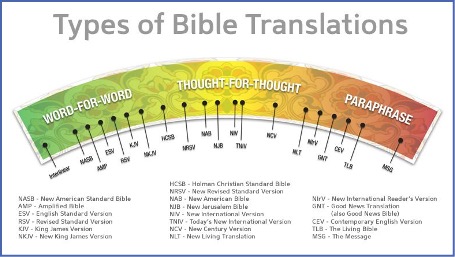
WE HAVE A CHART that will give you some sense of the Bible translation landscape.
Be grateful to Almighty God that He has made available so many different translations in English for believers, newcomers, scholars, and serious students alike!
The chart is printed below, but I’m going to describe it.
There are three basic classes of Bible translation: word-for-word, thought-for-thought, and paraphrase.
Word-for-word translations will provide the closest English equivalent to the original text word, be it in Hebrew, Aramaic, or Greek.
Thought-for-thought translations will give the English equivalent to a group of words forming a thought. In a sense, they smooth out the writing to make it more palatable to 21st century English-speaking ears.
The thought-for-thought translations cover a range from closer to word-for-word to closer to paraphrase, depending on the amount of license the translators used.
Paraphrase Bibles scrap the original writing and take a broad overview of the text. They might call their invention “holistic,” wherein they look at the “sense” of the passage as opposed to the actual wording.
Here is how our chart depicts the various translations:
HERE’S A SUGGESTION: Read the Bible. Pray to God. Spend time with the Holy Spirit. He will lead you where He wants you to go. Then go there.
For now, why not start with a reputable translation with wording that you can understand. As you delve deeper into Bible study, you’ll become more comfortable comparing versions.
Buy different translation Bibles or use one of the handy Bible apps for your phone or tablet that allow you to download multiple versions of the Bible in multiple languages. Use the split-screen option.
With a split-screen, you can read a word-for-word translation on the left side and a thought-for-thought or paraphrase version on the right side.
By reading them together, you’ll get a deeper sense of the original wording along with an easier-to-understand translation. The two together should help you draw closer to God as well as help you memorize various verses.
Experiment. Have fun! This is God’s Word you’re starting to discover. You’ll find that, if you’re serious about finding God, He’s more than equally serious about finding you.
How’s about this for encouragement: You will seek me and find me when you seek me with all your heart. – Jeremiah 29:13 (NIV)
Note that the wording is from the NIV that you’re so fond of. Experiment on your own to see how other translations compare.
Remember this promise: Draw near to God and He will draw near to you. – James 4:8 (NASB).
Okay, that was from the NASB. Check out where NASB is on the above chart. See where the NIV is and then read James 4:8 in your Bible.
Hey, ask one of those young ladies with the NCV or the GNT or even the man in the back with his KJV what their versions say. Ask them why they like those translations. Listen to them. Tell them your thoughts. Pray with them.
Together, all of you will be joining together on life’s greatest, most rewarding, journey!
Be a Berean!
Don’t know who the Bereans were? Check out Acts 17:11. Go ahead. Look it up. Yes, do it now. Try any translation. Try several!
You’ll be glad you did.
Then, once you’ve read that verse, be a Berean!
NARRATOR
WHAT DID YOU LEARN from that exchange between the Instructor and the Class? You saw 20 translations listed. There are more in English, including some I have used that are not listed, such as the BSB and the WEB. For those of you are fluent, or even semi-fluent, in a second language, you’ll have the advantage of adding more translations to compare.
A web search shows there are more than 450 versions of the Bible in the English language – with estimates of about 900 translations since the 16th century, when the printing press was invented. Most of those translations are no longer in print, having been updated or replaced. The exact number of translations depends on the definition one uses as to what constitutes a new translation versus a revision.
We know the various translations serve different purposes. Scholars and serious students will gravitate to the exact translations, while newer minds will find the easier-to-read options more inviting.
It looks like the instructor is ready to speak.
INSTRUCTOR
The word-for-word translations have the advantage of being truer to the original text being translated, so the accuracy rate is higher. In other words, we can say it is a “truer translation” to the original.
The disadvantage is that the writing often is stilted and can be more difficult for us to read and comprehend.
The thought-for-thought translations seek to rectify the comprehension difficulty of the word-for-word translations by rewriting the text, so it reads like your daily newspaper.
The advantage of comprehension is offset sometimes by slight-to-moderate deviations from the original writing, which can lead to a different interpretation of the text, so one needs to be careful when reading them.
The paraphrase options are the most suspect for serious Bible readers and scholars but often present the easiest-to-understand versions for the casual reader or new Christian.
As we can see, each style has its advantages and disadvantages, so I would recommend doing the following:
EXPERIMENT. Check out various translations and find the one or ones you like. As far as I can tell, there is no wrong choice, just be diligent in reading your Bible.
COMPARE. Read a side-by-side Bible, either in print or digital app version, so you will have a word-for-word translation side-by-side with a thought-for-thought version. That will give you the advantages of both – a truer translation plus an easier-to-read version. Compare both translations against a paraphrase to see if that helps you. It might or it might not. For paraphrases, I like the GNT and often use it in my writing, but I would not depend on it for my study or devotions.
The more comfortable you become reading your Bible, the easier it will be for you to identify the translation that fits you best, the one you turn to for your devotions and study.
NARRATOR – FINAL WORDS
I PREFER USING the New King James Version and the English Standard Version as side-by-side, but I also make heavy use of the Christian Standard Bible, Berean Standard Bible, and New International Version Bible.
In my Life Bible app, I have all five versions called up in two rows: In the top row, I have the NKJV and ESV side-by-side; in the bottom row, with skinnier columns, I have the CSB, BSB, and NIV side-by-side.
That gives me the range of translations I like while making it easier for me to read the NKJV with the ESV as a smoother version to read alongside it.
You’ll need to determine what system works best for you.
Remember: Keep reading your Bible!
PRAYER & BENEDICTION
ALMIGHTY GOD, LORD OF CREATION:
We are so grateful for the love You bestow on us.
You have given us a Bible that we can read and treasure, a book capturing the very words of Jesus Christ, the interpretative letters written by His closest followers, and the prophets and historians of the Old Testament, foretelling the Messiah.
Help these, Your faithful servants, as they go to their rooms for solitude and gather in groups for fellowship, to seek Your truth, Your Word, Your promises that, when followed, will enrich their lives and save their souls.
Whichever version or versions of Holy Writ they decide on, we pray Your encouragement for them to stay in the Word and not find daily excuses to avoid that very important Christian discipline.
As they do, O Lord, may Your Word continue to change their lives.
We lift this prayer in praise and thanksgiving. In Jesus’ name.
NOW, may the Lord bless you and keep you. May the Lord make His face shine on you and be gracious to you. May the Lord turn His face towards you and give you peace, both now and forevermore. AMEN and AMEN
Do you ever get discouraged when you focus on your life and wonder just what God has in store for you?
Do you ever get mad at God when you think you’ve been left behind and there’s more to life than what you have?
Do you ever believe, if even for a moment, that someone else is living the life that should be yours?
If you answered “yes” to any of those questions, or even if you’re not sure what your answer is, then today’s message is for you.
Fasten your seat belts, church. We’re about to take a ride into one of God’s most enduring and encouraging promises.
CHRISTIAN MESSAGE
By WARD PIMLEY
Pastor, Journalist, Author
In this you greatly rejoice, though now for a little while, if need be, you have been grieved by various trials … yet believing, you rejoice with joy inexpressible and full of glory, receiving the end of your faith – the salvation of your souls. – 1 Peter 1:6, 8b-9 NKJV
SUMMARY SENTENCE: God assures us through the Apostle Peter that He wants only good things for His children, but the primary goal of His calling on our lives is not to grant us our every wish for this life, although He often does, but to prepare us for glory, for an eternity with Him.
1. LIFE’S DISAPPOINTMENTS
LIFE DOESN’T ALWAYS work out the way we want it to, does it?
We pray for something, dream about, prepare for it … and, often, our dream doesn’t materialize; or when it does… whether it’s our graduation, or marriage, or a great job, or a bigger house, or a new car … we find the novelty, the excitement, the thrill dies quickly.
Or, we miss a cue. We fail to take advantage of the opportunities life brings us, or we make the wrong choices, or we labor in our own delusion for years, thinking we’re on the right track, only to wake up one day and regret the path taken.
You know these expressions:
If I only knew then what I know now.
I I had it to do over again, I’d __.
The grass is always greener somewhere else.
Ve Gedt Too Soon Oldt Und Too Late Schmardt [Pennsylvania Dutch for ‘Too soon old; Too late smart.]
The hurrier I go, the behinder I get.
Youth is wasted on the young. [Attributed either to George Bernard Shaw or Oscar Wilde.]
Let’s take a look at what verses 6-9 of 1 Peter 1 have for us.
2. WHAT IT MEANS
WHAT IT ALL means is this: We humans are apt to live much of our lives mired in regret.
For those of us who are more discerning, we draw comfort and inspiration from the Bible, where the Apostle Paul, addressing this issue, declared:
“My Christian friends, I do not think that I have reached that place yet. But this is what I do: I do not think about past things that have already happened. Instead, I try hard to reach the things that are in front of me.” – Philippians 3:13 EASY
LIFE LESSONS: (Spoiler Alert: Only the 3rd one works)
Get Back Up and Try Harder
Take Stock of the Situation and Adjust
Care for Our Soul – Find Our Peace and Guidance in God.
1. GET BACK UP
IN MY OWN life, I have experienced many of life’s challenges; and when I’ve failed, I try to rescue myself and push on.
That helps to some extent, doesn’t it? It certainly gets us moving again, and that’s a good thing; but it’s limited in its utility. Why? Because our self-help strategies at best are a temporary solution to what could be a long-term or permanent situation.
Personal Example – Marriage #1
Lack of wisdom (could not identify our difficulties)
Lack of spiritual bond (no common core)
Lack of family support (our families opposed the marriage).
There’s a maxim, credited to Albert Eienstein, that “Insanity is doing the same thing over and over again and expecting a different result.”
> Getting back up and trying harder does not change the situation; it only makes us more determined to try the same solution, expecting a better outcome. Imagine trying to break open a stuck door. Each time you thrust yourself at the stubborn door, you strike it harder, until, with a sore shoulder, you stop the effort. <
2. TAKE STOCK
TAKING STOCK MEANS looking for a better solution. Engaging our minds. This actually is an improvement over Trying Harder because at least we are engaging our mind, not just our will.
Getting back up and trying harder can be repeated ad nauseam before we realize that doing the same thing leads to the same end. So, eventually, we look for a better solution. When there’s growth, it comes when — or if — we look *inward* for a solution, instead of *outward.*
Personal Example – Marriage #2
Lack of shared experience (different life histories)
Lack of shared expectations (which one was to make us happy)
Lack of purpose (no children, no shared house, no clear vision, no spiritual core).
Admittedly, these are “big ticket” items. Marriage decisions impact our lives for years as well as the lives of our children and, therefore, of our grandchildren. Get it wrong, and you can mess up a bunch of lives for a long time, even generations.
If we focus solely on ourselves (our needs, our wants, our desires), we continue to overlook the bigger picture. What is going on here and why? If we focus on God, then we have a source we can go to for understanding and for comfort.
At this point in my life that I am describing, I focused solely on myself and my wants. God had not entered the picture. [Well, actually, He had, but I wasn’t aware of it yet.]
When I faced my second divorce, and afterwards a series of aborted relationships, some of which (I thought at the time) could have led to marriage, it slowly dawned on me that there was a common element harming each of those relationships … ME!
I was the common element. In short, I was the problem. I wasn’t the only problem, but I was the only problem I could fix. As the comic strip character Pogo said, “We have met the enemy, and he is us!”
No matter how much I wanted to blame someone else, this was my problem. I was a contributing factor, and it was my responsibility to fix it. My character, who I was inside, was broken and needed healing. Until I recognized that and began to deal with it, I would never heal.
>Taking stock of our lives is an improvement, for sure, over trying harder because it requires us to begin thinking about why our lives aren’t turning out the way we want them to. Taking stock becomes more valuable as a fix-it tool if we are willing to look at ourselves — to look inward — as the possible problem.
>However, it still doesn’t resolve our difficulties unless we’re willing to get help from an outside source. We can’t do this all by ourselves.<
So, when trying harder doesn’t work, and taking stock of the situation doesn’t include all of the relevant elements (like our own involvement), then we need a whole attitude adjustment.
This is what I came to see. When we can accept that we might be culpable for our own mistakes, our own faulty judgment, then we can begin to make necessary changes that could lead to a different, and better, outcome.
It can be discouraging to realize your own culpability, but I believe it’s the first step we can take to improve our situations. We can’t change other people, and we might have limited ability to change our environment, but we have a whole host of possibilities at our command if we focus on changing ourselves.
That brings us to our third point:
3. CARE FOR YOUR SOUL
I BELIEVE GOD gives us that grace so we can take the steps necessary to make change. One of those steps we take could lead us directly to God’s throne, which most likely is His intent.
What does it mean to “fix” something? How do you know what’s broken and needs fixing? Where do you go for the answers? Who can you trust?
We easily can get stuck. Some people get stuck at the *try harder* phase, while I – and others like me – can park for years on the *take stock* phase, blaming everyone and everything but ourselves, rolling different ideas over and over, while failing to find the right key — the one that unlocks the door.
All of those who are unwilling to open their lives to the Lord’s hand will find diversions to deaden their pain: overwork, entertainment, exercise, gambling, substance abuse, adultery — each of which carries its own penalty. Each one of them causes harm to the person physically or emotionally or financially, yet we hold onto our “fix.”
When, finally, we are willing to look inward, to look at ourselves, at what we bring to the equation, we can — in humility — begin to find workable answers. But since we’re on our third point — caring for our soul — we need to emphasize that *soul care* requires a personal relationship with the Lord. We cannot do that on our own.
Finding answers does not necessarily mean fixing or changing our situation; at least not right away. It might be limited to just fixing the way we react to a situation. Do we live in bitterness? Or do we live in God’s grace?
The Bible tells us not to blame God for our circumstances. He is not the cause of our problems, but He offers to be the solution.
He never promised us we would never suffer; He promised only that (1) He would suffer alongside us and (2) In the end, if we believe, our future will be in Heaven with Him.
God is more interested in our eternal state than He is in our temporal state, even though we, in our human frailty, mostly focus on the temporal.
“In all this, Job did not sin or charge God with wrongdoing.” – Job 1:22 BSB
“I have said these things to you, that in me you may have peace. In the world you will have tribulation. But take heart; I have overcome the world.” – John 16:33 ESV
“We know that all things work together for good to those who love God, to those who are called according to His purpose.” – Romans 8:28 NKJV
Just like a picture puzzle, there’s only one piece in the box that will satisfy the demands of that empty space you’re looking at.
ONLY ONE.
3. RECOGNIZING SOLUTIONS
GOD CAN BE so good to us. In my case, His goodness led to yet a third marriage, but this time to a born-again Christian. This was – and is – a grace note to my life.
Personal Example – Marriage #3
God did not have to restore my home life to include a wife. A good wife was not part of God’s promise to me for some accomplishment on my part, although she certainly is a bonus prize.
Also, God did not present this woman to me, much as eons earlier He had presented Eve to Adam, until after I had made two important life changes:
(1) I accepted Jesus as my Lord and Savior, and
(2) I humbly told Him I would accept His plan for my life, even if His plan did not include remarriage.
Within hours after I made that prayer, God brought that woman to my attention.
I never really fixed anything for more than a brief time until I examined my soul.
I FOUND THE ANSWERS TO MY QUESTIONS IN THE ONLY PLACE WHERE I COULD FIND ANSWERS: JESUS CHRIST.
Don’t say, “That’s just Christian Speak.” They always go there. No, folks, this is real. This is the real deal. Jesus Christ is the Answer to life’s baffling questions.
>Coming to faith in Jesus Christ was not an easy process for me, nor is it, really, for anyone because we’re called to submit our wills and our lives to Someone else. That can be very uncomfortable.<
That goes against our grain of self-determination.
We cling to that Free Will God gave us.
We don’t want to let go, even when letting go and letting God will lead us to a much better place than we can make on our own.
Even when we know it will, we’re often reluctant to trust God and take that fist step.
The Bible gives us encouragement and a warning:
ENCOURAGEMENT: “I am the vine; you are the branches. The one who remains in me and I in him produces much fruit, because you can do nothing without me.” – John 15:5 CSB
WARNING: “The prudent see danger and take refuge, but the simple keep going and pay the penalty.” – Proverbs 27:12 NIV
The actual steps are simple … yet, unfortunately, so difficult to accept.
Admit you’re a sinner,
Accept that Jesus is THE GOD MAN and that He lived a perfect life and died a painful death to atone for your sins, and
Then receive Him into your heart to be both your Savior and Lord.
Now, once we’ve come to accept the Lord Jesus as the master and ruler of our lives, then the real joy of living begins … because:
We are called as His disciples and followers to be on mission.
We are called to tell others what God has done for us.
4.GOD’S MARVELOUS PROMISE
HOW DO WE do that? How do we live on mission for others?
These are three things you can do, and I’m preaching to myself here, too:
We can pray for others – is there anyone you are called to pray for?
We can smile and be pleasant — are you a pleasant person to be around?
We can befriend them – do you routinely consider the needs of others?
Our church says we ought to live out our lives in such a manner that we earn the right to tell others about Jesus. Our lives are our first message to the world.
While humbling ourselves to accept Jesus can be difficult — we don’t like giving up control — we’ll never regret coming to faith, but we will regret not having come to faith sooner.
The Bible clearly states the terrible fate that awaits those who never come to faith. Pride leads to destruction.
Pride is …
The original sin
The great crippler.
LET’S RECAP THIS:
Trying harder doesn’t work because it yields the same result.
Taking stock is a step toward improvement because we’re starting to think about our situation, but its utility depends on our analyzing all the important variables – including those pointing back to ourselves. In the end, it still depends on self-improvement, which is limited in its utility.
Surrendering our lives to the Author of life is the saving grace because now we’re “teachable” and under the tutelage of the Master. It’s the only solution that works.
CONCLUDING SCRIPTURE: “In this you greatly rejoice, though now for a little while, if need be, you have been grieved by various trials … yet believing, you rejoice with joy inexpressible and full of glory, receiving the end of your faith – the salvation of your souls.” – 1 Peter 1:6, 8b-9 NKJV
SALVATION IS THE GREAT HOPE.
THAT HOPE IS WHAT GIVES US JOY, COMFORT, AND PEACE IN THIS WORLD.
FINAL WORD
JESUS’ GRACE is sufficient even when our faith is weak.
There is no need to despair.
There is no need to fear, nor be tormented by regrets, or constant wishful thinking.
Believe in Him. He always tells us that He is the answer to life’s questions.
This is a lesson for me to learn, too. Like many of you, I struggle with regret.
But whenever I focus on God – not on myself but on God – then my regrets float away, like a mist of smoke.
Whenever I focus on myself, those regrets come storming back.
IF YOU HAVEN’T turned your life over to God, or you’re not sure if you have, let’s take care of that now.
IF YOU’VE DRIFTED AWAY from the Lord, but want to reconnect, let’s take care of that now, too.
IF YOU HAVE turned your life over to God, let’s celebrate that and praise God for His goodness.
God keeps His promises. You will not lose your salvation.
Why? Because you did not earn it.
God gave it to you as a gift.
This gift results from His grace.
He wants to spend Eternity with you.
Together, we can pray prayers of contrition, reconciliation, and praise.
PRAYER
LORD, I AM A SINNER. I need Your forgiveness and Your grace. I believe Jesus is the Messiah, that He is Your Son, that He lived a perfect life and died on Calvary’s Cross for me, and that by believing in Him, I will be clothed in His righteousness, and You will forgive my transgressions and save even me.
ABBA, Daddy, come into my heart today, and be both My Lord and My Savior.
For those of us who have given our lives to God, we thank You, O Lord, for Your grace, for the boundless gift of life that You have promised Your own.
Now draw us closer to You, O Lord, that we might walk as Jesus walked and talk as Jesus talked, all in Your name and for Your glory.
Lord, we honor You, we praise You, and we worship You. We lift this prayer in the mighty name of Jesus Christ.
BENEDICTION
HEAR THE WORD OF THE LORD AS WE END OUR WORSHIP AND GO FORTH …
“For you have been born again, not of perishable seed, but of imperishable, through the living and enduring word of God.” – 1 Peter 1:23 BSB
This blog has been devoted to Christian meditations, but this is a first step in broadening its reach to topical issues.
These discussions will be based on biblical principles as our Christian faith should inform our positions and viewpoints.
So, here goes …
COMPETING VIEWS
EVERYONE IN THE WORLD knows of the recent “dust-up” between Israel and Iran and between Israel and Iran’s proxies — Houthis, Hamas, and Hezbollah — the three Hs.
The question is, from a Christian perspective, what should be the position of the United States? Should we as a country become involved in a military contribution on the side of Israel, and if so, to what extent?
Let’s examine two possibilities: First, that Jesus preached non-violence, leading us to avoid unnecessary use of armed force. This view would emphasize using the bully pulpit, combining the pulpit’s teaching side with its preaching side.
This view would exhaust all “soft” policy, which is “statecraft” or negotiation, before engaging in “hard” policy, which calls on military force as a last resort.
“If any of you lacks wisdom, let him ask God, who gives generously to all without reproach, and it will be given him.”– James 1:5 ESV “For the Lord gives wisdom; From His mouth come knowledge and understanding.” – Proverbs 2:6 NKJV
The chief alternative considers the biblical response to evil. In the Old Testament, the Jews were to wipe out the natives in the Promised Land because God’s patience with them and their evil had worn out. He was imposing judgment on them.
In Revelation, we see Jesus will wipe away all evil with just the spoken word – His Word, not ours – as He rides on a white horse from Heaven to take His throne in Jerusalem to reign over the land in the Millennium.
The account of three battles in Revelation – Gog and Magog, Armageddon, and the final, unnamed battle, will spill tons of blood as God eradicates evil from the world.
God’s wrath is righteous anger, while ours often is self-centered and harmful to community.
So, how would we settle this discussion? Engage militarily or speak our truth into the storm?
SPEAKING BOLDLY
BOTH VIEWPOINTS have merit, but one point this column would make is that whichever course the church takes, it should speak boldly and without compromise.
How then can the church speak conflicting viewpoints boldly and without compromise?
All such questions can be answered via the same formula: walk with the Lord, seek His counsel, read His Word, pray to Him, and seek His face. As we draw closer to Him, He will draw closer to us and reveal His answer.
Let us as the church never chart any course without first seeking the Lord’s face and asking for His counsel. We should not ask Him to bless whatever it is we decide.
This column questions how many in the church universal are seeking His face, turning to Him for His answer rather than asking Him to bless their answer.
The view of this column is that the U.S. should make strong statements in support of Israel and its right to exist and that Israel is to own the land given to it by God. That includes Gaza, the Golan Heights, and Lebanon.
This column also believes the U.S. should bless Israel and support Israel through military might and that the bombing of Iran’s nuclear reactor sites was proper and in line with God’s declaration of support for the Jewish people.
SEEKING HIS FACE
MORE IMPORTANTLY than making a one-time decision is the process by which we continually seek God’s answers to our questions.
Let us as the church never chart any course ourselves without first seeking the Lord’s face and then asking Him to bless whatever it is we decide.
This column is clear that the U.S. took the right course in bombing Iran’s nuclear facilities and then seeking a peace settlement, but at no time does this column end the process of seeking God’s face.
We should always be humble, come together in prayer, learn from one another, and follow God’s lead as we understand it.
We might well find that as we do so, God will reveal more of His commandment to us such that we will mold our response in some way, much like sanding a block of wood makes the block more aesthetic, easier to handle, and more useful.
PRAYER
ALMIGHTY GOD, PRINCE OF PEACE,
You are both the Lion and the Lamb,
the conquering warrior and the humble sacrifice.
Lead us into making the right decisions in all matters of public policy, that we as a church may represent You in truth and honor, according to Your desires, not according to our own.
Lord, we bless You and thank You, we praise You and we worship You.
Our God left nothing to chance. He exists, and He wants us to know who He is. Moreover, He wants us to know His character and His plan for creation and for us, His people, whom He fashioned in His image.
MESSAGE BY WARD PIMLEY
“I know now that the Lord is greater than all other gods, because he rescued his people from the oppression of the proud Egyptians.” — Exodus 18:11 (NLT)
“Now this is eternal life: that they know you, the only true God, and Jesus Christ, whom you have sent.” — John 17:3 (NIV)
Who hasn’t woken up in the middle of a deep sleep — maybe that proverbial 3 am midpoint — and wondered in panic, “Where am I?”
In the light of day, that question often morphs into “Who am I?” and “Why am I?”
Those questions, and others like them, have occupied the minds of nearly all of mankind since our earliest days, with some of the greatest minds spinning yarns as they attempt answers for themselves and for us.
Often — most often — they are wrong.
Why?
Because they leave out of their equation the Creator of everything, the God who spoke life and matter into being. He and He alone determines the correct answers to those questions.
~God Speaks~
FOR GOD TO COMPLETE HIS PLAN, He has given us “general revelation,” which is God speaking to us through creation itself, the majesty of the world and the universe around us, even down to the smallest specks of stuff we can see only through the most powerful microscopes.
For those of us who believe, He has given us something more. It’s called “special revelation,” and it’s the Word contained in the Holy Bible, interpreted for us by the Holy Spirit.
Through the answers God has given us, we can draw comfort in knowing there is a Plan, written by a Creator of mighty power and incredible intelligence, who – fortunately for us – is loving, patient, forgiving, merciful, and grace-filled.
Imagine the terror that would befall us if our God were angry, mean, and unforgiving.
~Man’s Stubborness~
WHY, THEN, DO so many people turn away from God’s invitation to meet Him and enjoy a personal relationship with Him?
Because we are stubborn.
Somehow, in our self-importance, in our arrogance, we think we know better than God does how we should live our lives and what should occupy our time.
When we do that, at some point, we might realize we chose wrongly. For the unfortunate, that point never comes; for others, it comes so late in life, there’s little they can do except enjoy a brief course correction.
But for those who come to that point early in life, God’s radiance can guide their steps through the peaks and valleys that mark our days, leading them along the pathway set out for them by their Creator.
~FLICKERING LIGHTS~
THEY ARE THE ONES who live the most fruitful lives. They are the ones we call on when we are mired in our own mess. They are God’s flickering lights showing us a straighter path.
They walk with a self-confidence knowing a personal God is Sovereign and ruling from His throne; they know life’s battles have been won by the One on the throne; they can testify to the joy and peace God has given them in exchange for their faithfulness.
That life is available to all of us, if we choose it.
Just open your heart to a prayer like this one:
“Lord God Almighty, I know I am a sinner in need of Your forgiveness. I believe Jesus Christ is Your Son sent to die on the cross for my sins, and that by believing in Him, You will transform my soul and reward me with eternal life in Your presence. Lord, I want that. Come into my heart and save even me.”
That’s all it takes, but you have to be genuine. If you are, the Holy Spirit will bath you with His presence and remake you into the image Your Creator designed you to be.
O Happy Day!
~PRAYER~
ALMIGHTY GOD, Our Lord and Savior — Thank You for loving us, for creating us and fashioning us in Your image, male and female, equal in worth but designed for different and complementary roles. Thank You for being a God that spreads joy and peace, patiece and kindness, faithfulness and peace. Lord, thank You for salvation. In Jesus’ name we lift this prayer. AMEN
As followers of Jesus Christ, it’s not enough that we proclaim our faith; we also need to live as He lived, to act and talk in a way that glorifies Him. Why? So we can lead more people to place their trust in Him for their salvation. With His help, we can do all that despite our personal failings.
1 John 2:6 (NKJV) “He who says he abides in Him ought himself to walk just as He walked.”
1 Juan 2:6 (RVR1960) «El que dice que permanece en él, debe andar como él anduvo.»
Message By Ward Pimley
You’ve heard that popular saying: “Walk the walk; don’t just talk the talk.”
You know what it means: It means to be “authentic,” to be the “real deal,” to live out your life, your everyday life, in the same manner, according to the same guidelines, that you say you do. 1 John 2:6 NLT says it this way: “Those who say they live in God should live their lives as Jesus did.”
As followers of Jesus Christ, we proclaim to the world that we believe in Him, that we listen to Him, and so we also ought to live as He lived.
THE BIBLE – Where God’s Answers Meet Man’s Questions
Since that’s an impossibility — we are not perfect as He is — we need to add the caveat that we *try* to live our lives as He showed us how to live, but that in our failings, when we humbly come to Him and repent of our faults, He is faithful and just and will forgive us our sins. (1 John 1:9)†
CHRISTIANITY’S GIFT TO MANKIND
THAT IS THE REAL GIFT we Christians offer the world.
That’s why we’re different, and it is in that promise, that relationship with Almighty God, that we are given the greatest gift possible — eternal life in Paradise with God (Luke 23:43; 1 John 2:25).
Do you know the Lord? Do you really *know* Him? Do you have a personal relationship with Him? If you do, you will enjoy the promise that God, who cannot lie, has made — eternal life with Him.
If you do not have a personal relationship with Him, there’s another promise that God, who cannot lie, holds out to you — eternal life without Him.
If you choose to live in this world with Him, you will spend eternity with Him. If you choose to live in this world without Him, you will spend eternity without Him,
Which future do *you* want?
~PRAYER~
If you want the peace, the joy, and the abundant life that God promises (John 10:10), then humbly and sincerely recite this prayer (or use your own words expressing the same thought):
FATHER IN HEAVEN, I am a sinner in need of Your forgiving grace. I believe in Your Son, Jesus Christ, and that He lived a sinless life to become a sacrifice for my sinful heart and then suffered and died on the Cross to bear the wrath that I deserve. Lord, this gift of atonement is so wonderful – I want it for myself. Please forgive me, Lord God, and send Your Holy Spirit into my heart. Become my Savior, but even more than my Savior, come into my heart and be my Lord. With a grateful and believing heart, I pray.
AMEN
IF YOU GENUINELY PRAYED THAT PRAYER (OR ONE LIKE IT), WELCOME TO THE KINGDOM OF GOD!
WHAT AN AMAZING ASSURANCE! Jesus is our Advocate in Heaven, speaking on our behalf to the Father.
I John 2:1 (NKJV) “My little children, these things I write to you, so that you may not sin. And if anyone sins, we have an Advocate with the Father, Jesus Christ the righteous.”
1 Juan 2:1 (NTV) “Mis queridos hijos, les escribo estas cosas, para que no pequen; pero si alguno peca, tenemos un abogado que defiende nuestro caso ante el Padre. Es Jesucristo, el que es verdaderamente justo.”
Weekly Message By Ward Pimley
WHAT AN AMAZING ASSURANCE! Jesus is our Advocate in Heaven, speaking on our behalf to the Father. That is so important, because as we read in the Book of Job (Job, Chapters 1-2) and even now is in Heaven accusing us of all manner of sins and disobedience (1 Peter 5:8; Rev. 12:10).
“Did you see that!” Satan points out. “Did you see what John did, what Sally said, what Bob and Heather are doing! Hold their actions, their words, against them!”
Jesus Is Our Advocate Before the Father
Yet Jesus is speaking on behalf of those — don’t miss this point — who trust Him for their salvation. The Bible tells us that those of us who know Jesus as our Savior are the true children of God, and those are the ones for whom Jesus advocates.
That means that if ~you~ have come to Jesus and received Him into your heart, confessing your sin to Him and repenting in sorrow, He will send the Holy Spirit to wash you clean of impurity, to guide you into all righteousness, and to hold you tight as a guarantee of your salvation.
Plus, and this is the bonus part, Jesus will ~advocate~ for you, on your behalf, to the Father and thwart the vicious claims against you levied by the Enemy.
“Yes,” He will tell the Father, “John did this, and Sally said that, and Bob and Heather were wrong, but, Father, ~they are with Me.~ They are mine! I have paid the price for their sin. I am holding them in My hand for all eternity.”
My friends, it doesn’t get any better than that.
LIFE CHANGING MOMENT
IF YOU HAVE NOT TURNED your life over to the Great Promise of Life and Redemption, would you do so now? Here’s what you should do: Pray with me (or use your own words to mean the same thing).
Heavenly Father, I am a sinful man/woman in need of grace. I am sorry for my sin and seek the redemption and cleansing that is possible only through the blood of Jesus Christ, Your Son, which was shed on the Cross for me. Lord, forgive me and have mercy on me. Come into my heart now as my Savior and as my Lord, and transform me to walk as You walk. Lord, I pray this humbly in the name of Jesus. AMEN
IF YOU HAVE PRAYED THAT PRAYER (or one like it) and genuinely mean it, then Welcome to the Kingdom of God! You are now a true child of God, and your soul is forever held in the hands of the Father and the Son, with the Holy Spirit as your down payment, as your guarantee of a future reward. Now, go and tell someone about what God has done for you and how God can do the same thing for him (her).
May God bless you as you go …
PRAYER
ABBA FATHER, Thank You for giving us an advocate, who speaks on our behalf, assuring You that our sin has been washed clean by His blood and that we are now spotless in Your eyes. Lord, that assurance gives us great comfort as we hold dear to Your promises of forgiveness, grace, mercy, and eternal joy with You. Lord, remove all barriers between us so our fellowship with You will be restored and never shattered, that we will hear Your voice, Lord, and You will hear our prayers. Lord, we offer this prayer in the magnificent name of Your Son and our Savior and Lord, Jesus Christ.


















 Ward's Words | BY WARD PIMLEY