In Part 2 of a 3-part series, “Parallels With Jesus,” we examine the life of Job, a man who, like Jesus, suffered, and, like Jesus, maintained his faith in God’s mercy and goodness. Previously, we looked at Jesus and Joseph. Next, we’ll look at Jesus and Daniel.
I know that my redeemer lives, and that in the end he will stand on the earth. (Job 19:25 NIV)
For Christ did not enter a holy place made with hands, a mere copy of the true one, but into heaven itself, now to appear in the presence of God for us. (Hebrews 9:24 NASB)
TWO MEN. TWO BATTLES WITH SATAN. ONE OUTCOME — SATAN LOSES.
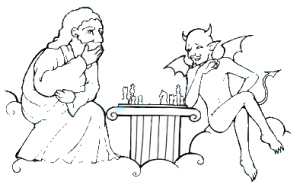 How did Satan lose? Was it because of the superior attributes of the two men doing battle with him? Or was it something else? Was another force involved that tipped the scales away from Satan?
Here are the two men: Job in the Old Testament and Jesus Christ in the New Testament.
Let’s set the stage: In Job, Chapter 1, Satan is holding a conversation with God and claims that Job’s faith in the Creator is based solely on the health and material blessings God has bestowed on him. Strip Job of his blessings, Satan argued, and his faith will disappear.
Okay, we can understand the point that it’s easier to sing Praises and Hallelujah when you’ve got a good marriage, a big house, a wonderful job, obedient children, two cars, and a vacation home, but if you lose all the “stuff,” there goes the faith.
Now, let’s swing over to Jesus. In Matthew, Chapter 4, just after Jesus has emerged from His baptism in the Jordan River, He was led by the Holy Spirit into the wilderness “to be tempted by the devil.”
Satan was then given the opportunity to challenge Jesus on whether He really was the  Son of God. Now, Jesus believed He was. In fact, in the preceding chapter, Matthew tells us the voice of God said, “This is my Son,” which should settle the matter.
+++
WHAT IS CLEAR WITH BOTH the temptation story facing Job and that facing Jesus is that Satan, the tempter, was striking at their faith in God. He tried to rattle them and force them to recant their belief that God exists, that He created us, and that He is present in our lives.
We all face temptations in our lives, and Scripture is clear that how we handle those moments helps shape our character and our witness for our belief in Jesus Christ.
But look at what Jesus and Job went through. For Jesus, the second person of the Trinity, we read that the Holy Spirit, the third person of the Trinity, purposefully led Him into the wilderness for the express purpose of being tempted.
Not only that, but the temptations did not begin until Jesus had fasted for 40 days and 40 nights. At that point, He would have been weak with hunger and more easily susceptible to wrongdoing.
 In our own lives, we know we are more likely to give into temptations, whether of actions or words, when we are tired or hungry or upset about work.
Imagine how we might react if we had been fasting for five weeks.
+++
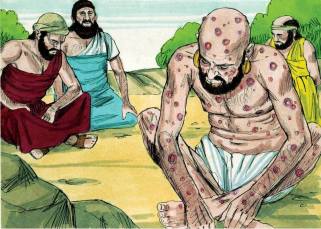
Job’s temptations were a complete surprise to him, as far as we can tell from Scripture. We read that “one day” everything is going along pretty much for him the way every day went, when a succession of messengers ran up to him to announce that his farm animals were taken and his servants slaughtered.
After three such messages, he receives a fourth message that tops the first three: His sons and daughters were partying, and the house in which they were gathered was felled by a mighty wind, killing them all instantly.
As we read through the succession of calamities that befell Job, we see him rent with despair but calling out to God for salvation: “Then he fell to the ground in worship and said: … ‘may the name of the Lord be praised’” (Job 1:20-22 NIV).
Jesus did much the same thing. As He was faced with temptations, from turning stones into bread to jumping off the top of the temple to worshipping the devil with the offer of his earthly kingdom, Jesus quoted Scripture.
The verses were all from Deuteronomy: “Man does not live by bread alone, but on every word that comes from the mouth of God,” “Do not put the Lord your God to the test,” and “Worship the Lord your God, and serve him only” (Matthew 4:1-11 NIV).
+++
GOD IS CLEAR IN HIS REVEALED WORD that our temptations are designed to improve our character. Paul tells us in Romans 5:3-4 NIV that “we also glory in our sufferings, because we know that suffering produces perseverance; perseverance, character; and character, hope.”
This is the point where it becomes clear that Satan may win some battles in the short run, but in the long run, God wins the war.
God also reassures us through Paul’s writing in 1 Corinthians 10:13 NIV that “No temptation has seized you except what is common to mankind.” That means, whatever you are dealing with, others are, have, and will face, as well.
But Paul goes on to tell us that “God is faithful; he will not let you be tempted beyond what you can bear. But when you are tempted, he will also provide a way out so that you stand up under it.”
Job certainly knew that he could count on God’s goodness and faithfulness. In Job 19:25 NIV, Job proclaims his undying faith in God: “I know that my redeemer lives, and that in the end, he will stand on the earth.”
 Jesus also knew that He could count on the Father’s love and presence. Immediately after He faced His trials, He began His public ministry, preaching, “Repent, for the kingdom of heaven is near,” which meant himself. Then, he called His first disciples, so He could begin to build His church (Matthew 4:12-22).
“Come, follow me,” He said, “and I will make you fishers of men.”
Those two models show us that even in the most trying of situations, God is faithful, and He is always there to help us.
Take that, Satan. Now, be gone …
+++
PRAYER: Our gracious and loving Heavenly Father. We are so grateful that You are sovereign, that You are watching over us and helping us, as You promised You would, through the valleys of life, just as You are with us when we’re experiencing the blessings. Forgive us, Lord, when we doubt or wander away from Your presence. Bring us back every time into Your loving arms. We ask this in Jesus’ Name. Amen
 So, with that settled, what does the “unfairness of unfairness” have to do with us? How is that relevant to our lives?
 His disciples and followers, and they hated His condemnation of their legalistic teaching. Why, Jesus even healed the blind and crippled on the Sabbath — and they hated that!
 of the high marks — or low marks — of their remarkably parallel lives.
 There might be more items we can offer, especially if God has placed on our hearts a love for His creation. In that case, we can bake a casserole or help someone take down storm windows, or even pick up a few items while we’re in the grocery store.

 Keep in mind that the religious leader was a scholar extremely well versed in the Jewish canon — what Christians call the Old Testament — and probably could quote most, if not all, of the Torah, the books compiled and written by Moses.
 been crucified, resurrected from the dead, and ascended into Heaven. In this second view, from the book of Revelation, John is in his later years and sees a vision where the Holy Spirit takes him into Heaven.
 Holy Spirit descended on the apostles (Acts 2:1-4), they realized they had walked with God incarnate!
 Truth, “Sanctify them by the truth; your word is truth” (John 17:17 NIV).
 Yes, there’s an amazing transformation between Jesus the God-Man who walked the earth to establish a New Covenant with man—His prized creation—and Jesus, the resurrected Son of God and Second Person in the Trinity, to whom God has given “all authority in heaven and on earth” (Matthew 28:18 NIV).
 how us how it was to be done. In Philippians 2:8, the apostle Paul says Jesus “humbled Himself” to leave His spot in Heaven for an earthly stint as a mere human and, in addition, “was obedient to death” for our eternal benefit.
 Not only did He set the example for us by laying down His life for ours, but He tells us not to worry. “Do not be afraid of those who kill the body but cannot kill the soul,” He told His disciples. “Rather, be afraid of the One who can destroy both soul and body in hell” (Matthew 10:28 NIV).
 Jesus Christ!
 straight path (Proverbs 3:5-7; Psalm 119:105). He should be walking alongside of me, to encourage me (1 Thessalonians 5:11). He should be walking behind me to pick me up when I stumble (Ecclesiastes 4:9-10).
  er and foremother thought they knew better. So, they disobeyed. God was true to His Word. He banished them from the Garden; their work, once glorified, now became a burden; and they were under a death sentence.
 Now, about that back pain.
 Rewriting God’s Holy Word is the favored tactic of those who claim to honor the totality of Scripture, as they see it, while dishonoring specific commandments and directives that cut across their “lifestyle.” In other words, they are willing to hold God to His promises of salvation and mercy but insist that His guidebook to us needs updating “to fit the times.”
 I will not give My glory to another,” (Isaiah 42:8 NASB) — even though He commanded our forebears to take responsibility for tending to creation (Genesis 1:28 NIV).
 pick and choose whatever suits, as long as one eats everything on one’s plate?
 eans little to us, just a slight reference to nationality, nothing significant, so we let it pass.
 Ward's Words | BY WARD PIMLEY