This is Part 2 of a 6-part meditation on Galatians. Part 1, “No Other Gospel,” is available at Galatians 1.
Missed a blog post? Find prior posts at LoveAndGrace and tweets at Twitter.
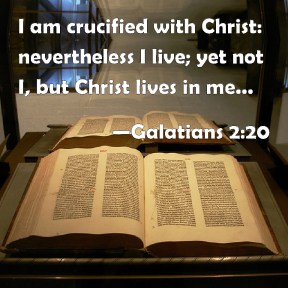
“I have been crucified with Christ. It is no longer I who live, but Christ who lives in me.” (Galatians 2:20a ESV)
“Yet we know that a person is not justified by works of the law but through faith in Jesus Christ … because by works of the law no one will be justified.” (Galatians 2:16 ESV)
 GRACE IS GOD’S FREE GIFT TO MANKIND.
It is a gift that was not chiefly bought nor casually given. In fact, the apostle Paul says our very bodies are temples in which the Holy Spirit lives. “You are not your own,” he writes. “You were bought at a price. Therefore glorify God with your body” (1 Corinthians 6:20 BSB).
What boggles the mind is this: Considering the stakes at hand — our eternal, everlasting, without-end destiny — you might think mankind would rush into the open arms of Jesus Christ, thanking Him profusely with tears and hugs for providing God’s grace through His sacrifice on the Cross for us.
You would be wrong.
Most people appear to be stuck on the words “It is no longer I who live, but Christ who lives in me,” and that’s where they stop. They don’t want any part of it, no shifting of controls from me to Him. It’s my life, and I’ll live it the way I want to. Stay back, Jesus.
Unless I need Your help, then I’ll let You know.
+++
DOES THAT BOTHER YOU?
It bothers me.
Aren’t you totally bummed to realize that most of the smiling faces you’ll encounter today are not remotely interested in receiving the grace offered by their Savior, nor are they willing to let Him take the controls of their earthly lives, even though the payoff is eternal life instead of eternal punishment.
Even the introductory clause of having been “crucified with Christ” is a meaningless 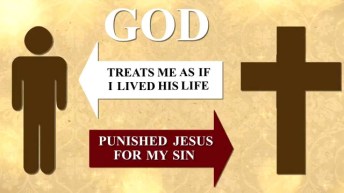 mess of words for most people, who have no idea what that means.
Really, for most people who have ever lived, the Cross was just a tragic end a long time ago in a primitive culture for a man who might well have been a gifted teacher and, possibly, an extraordinary healer, but it was nothing more than that.
Those who lived before the Cross ignored the law and the prophets.
For those of us who believe, however, it is the most incredible act of love and self-sacrifice the world has ever witnessed — at least, that part of the world that’s paying attention.
Paul, again, tells us that “God made the one who did not know sin to be sin for us, so that in him we would become the righteousness of God” (2 Corinthians 5:21 NET). The apostle Peter called the crucifixion the shedding of “the precious blood of Christ, the sinless, spotless Lamb of God” (1 Peter 1:19 NLT).
But what is that to an unbelieving world?
Paul, again, states it this way: “For the word of the cross is folly to those who are perishing, but to us who are being saved it is the power of God” (1 Corinthians 1:18 ESV).
+++
SO, WE’VE SEEN THAT MOST PEOPLE do not want to cede control over their lives to the One who can give them life, and life abundantly (John 10:10), but what about that second part, about being “justified” by works or by faith? What’s up with that?
“Justification” is just a big word that means a person has been made “righteous in the sight of God.”
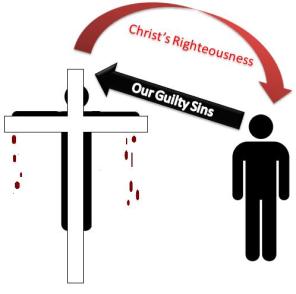 Paul says it this way: “not because I have my own righteousness derived from the law, but because I have the righteousness that comes by way of Christ’s faithfulness—a righteousness from God that is in fact based on Christ’s faithfulness (Philippians 3:9 NET, emphasis mine).
In other words, Jesus lived a sinless life, and God credits His righteousness to my account — blotting out my sin-stained life — the moment I accept His Son as my Lord and Savior.
That transfer of Christ’s righteousness for my unrighteousness is my Ticket to Paradise!
The really big deal with that is that the alternative way to earn God’s favor is for me to live a sinless life — and I lost that one a long time ago.
“There is none righteous, no, not one,” Paul writes. “There is none who understands; There is none who seeks after God. … There is none who does good, no, not one” (Romans 3:10-12 NKJV).
The prophet Isaiah was just as blunt, saying that in God’s eyes, “All of us [that includes you and me] have become like one who is unclean, and all our righteous acts are like filthy rags” (Isaiah 64:6 NIV).
+++
Most of us probably figure we’re on the good side of the Bell Curve. We haven’t killed anyone, or cheated on our spouse, or stolen our neighbor’s car, so we’re good.
Not so fast. Not in God’s eyes.
See, God is perfect; we are sinful.
James, the half-brother of Jesus (they shared a mother), tells us this: “If someone obeys all of God’s laws except one, that person is guilty of breaking all of them” (James 2:10 GW).
 All of them. Murder. Rape. Adultery. Theft. Slander. Lying.
Lest we think somehow God only keeps a record of what we do, no, He also keeps a record of what we say and what we think, as well.
Try this from Jesus’ own lips: “But what comes out of the mouth [our words] comes from the heart, and this defiles a man” (Matthew 15:18 HCSB).
And what about thoughts? “Knowing their thoughts, Jesus said, ‘Why do you entertain evil thoughts in your hearts?’” (Matthew 9:4 NIV).
How about this one from Jesus: “You have heard that it was said to our people long ago, ‘You must not murder anyone. Anyone who murders another will be judged. But I tell you, if you are angry with a brother or sister, you will be judged’” (Matthew 5:21-22a NCV, emphasis mine).
+++
THERE’S JUST NO WAY AROUND IT.
What we do, God sees as “filthy rags”; what we say, God sees as “defiling” us; and what we think, God sees as “evil.”
So, we are totally dependent for our salvation on Jesus Christ.
Considering how we don’t measure up in God’s eyes, those words from Scripture that we quoted earlier now sound beautiful and reassuring. I have been crucified with Jesus Christ. Christ lives in me. We are justified not by our good works but through faith in the Christ.
Paul said it clearly in Ephesians 2:8 NLT: “God saved you by his grace when you believed. And you can’t take credit for this; it is a gift from God.”
Amen, brother.
Now, that’s Grace!
+++
PRAYER: Holy Father, Lord God Almighty, we are so unworthy to approach the throne with our petitions except through the blood of Jesus Christ. Would You forgive us for our lack of faith? Would You soften the hearts of our family members, friends, and neighbors who do not know You or care to learn about You? Would You just grab us in Your loving arms and never let go, even when we act, talk, and think viciously evil, self-defiling filth? God be praised with all power, honor, and glory forever. Thank You, Lord Jesus, for Your amazing sacrifice for us. Thank You, eternally, Lord Jesus, for claiming us as Your own. Amen
 Sadly, many so-called Christians today — operating under the rubric of “progressive Christianity” — are busy revising the Gospel to “update” it according to contemporary society’s “reason” and “experiences.” They base their doctoring on a perverted sense of God’s loving nature, while conveniently ignoring His role as humanity’s judge.
  He died for us] to deliver us from the present evil age, according to the will of our God and Father” (v. 4 ESV).
 but I received it through a revelation of Jesus
 “inclusivity” and “tolerance” and “love” is not godly.


 Anyone can strive to “get real” on their own — maybe slap some “great sayings” on the refrigerator; determine to increase personal motivation to stay positive or smile more or say “please” and “thank you” to a stranger, even when they probably don’t deserve it; and maybe stick a toe into a non-profit service center now and then.
  Mention a saving faith in Jesus Christ, and many, if not, most non-believers quickly claim that God, the creator of the universe, is a “cosmic killjoy,” who “cramps their style.”
  God’s
God’s  Through Jesus Christ and Him only.
 In a pivotal scene in the Bible, known as The Fall, we see Adam and his wife, Eve, standing by that same tree that God told Adam to avoid. What were they doing? Talking to a serpent (Satan), who was encouraging them to disobey God. How? By casting doubt on whether God really said they would die (Genesis 3:1).
 special, more important than a lame, “How are you?” or “What are you planning for the rest of your life?”
 confessed your
 be
be As former children, ourselves, we know the scary moments in our darkened rooms when we awake, uncertain of our surroundings but certain something ghostlike hovers about. So we call out to our parents to scamper forthwith, turn on the lights, and maybe bring a glass of water with them.


 God gives, and man, well, sometimes man is gracious enough to take … but not always. In fact, the Bible notes that most men and women will not take God’s gifts, but prefer to go their own way.
 caused Him anguish in anticipation of what lay ahead — was experiencing His Father’s wrath for our sakes — for every sin we’ve ever committed, are committing now, and will commit — and He endured that for everyone who has ever lived, is living, or will live.
 Painful, indeed, to watch God’s chief creation being so disobedient, but for those who respond with a grateful plea, “Come into my heart, Lord Jesus! Forgive my sins and live in my heart for eternity,” there is joy in heaven (Luke 15:7).
 There are two young adults — one male, one female, both sinless — enjoying the goodness of God’s love and His many blessings.
 Lovingly, He rebukes them and dishes out the punishment they have incurred on themselves — Adam will work hard for his provisions; Eve will suffer in childbirth — but God promises to restore the promise, telling the serpent that God has put “enmity” between the devil’s seed and Eve’s, because Eve — or another Eve down the line named Mary — will bear God’s Son, who will “crush” Satan’s revolting head (Genesis 3:15).


 Sometimes, it needs a bold declaration of God’s love for His creation.
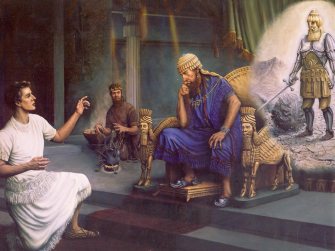 But he does not want to be fooled. Instead of first telling them the dream and then asking for their interpretation, he tells the wise men they have to describe the dream to him and then tell him their interpretation.
 Yet Jesus “would not entrust himself to them” (vv. 23-24 NIV) because He knew what was in their hearts.

 Ward's Words | BY WARD PIMLEY