

A CHRISTIAN MESSAGE
BY WARD PIMLEY
Pastor, Journalist, Author
NARRATOR
IT IS NORMAL for a new Christian to be confused, excited, and scared. This is new terrain.
The same is true for our friends who are actively seeking answers to their questions about Christianity. We call them “seekers,” and even those skeptics who are beginning to doubt their disbelief.
To help, we have prepared a series called, “Real Questions Asked by Newbies, Seekers, and Skeptics.”
See the first item, I AM A NEW CHRISTIAN. NOW WHAT? at HERE.
We might title this lesson: “I WANT TO KNOW THE TRUTH.”
Today, we have the privilege of eavesdropping on a New Believer’s class, and I believe the instructor is laying the groundwork for a discussion about the integrity of our Bibles. Can we trust its 66 books to deliver the truth?
Let’s listen in, shall we?
INSTRUCTOR
THE BIBLE TELLS US that when we are regenerated, or redeemed, by the Holy Spirit, we become a “new creation” (2 Corinthians 5:17) and so we are.
Last time, in our prior message, we learned that, as new Christians, we are regenerated (spiritually alive), redeemed (bought with a price), justified (our debt paid), adopted (become part of God’s family), and united with Christ (we become one with the Son).
So, when we want to grow in our knowledge of what it means to be a Christian, when we want to know what is “right” as opposed to what is “wrong,” where do we go for the answers? Who, or what, can we trust?

Most Christians go to church with some regularity, and that becomes the limit of their devotion. They don’t read their Bibles, they don’t pray daily, and they don’t witness for their faith. When their church service is based mostly on ritual, they don’t learn anything, either.
As a result, we come a church that is “biblically illiterate.” A biblically illiterate church is ill-equipped to discern false teaching and so can go astray.
For those Christians, once church is “over,” they’ve “done” church, and they go back to the real world without another thought about God and His design for us until the next time they go to church.
That’s why, in this series, we’re going to discuss some of the basics of Christian doctrine and emotions so we can grow in our faith.
As Christians, we’ll assume we go to the Bible for the answers, but that leaves the question: Which version or translation of the Bible is the most reliable?
Some people, especially skeptics, doubters, and the downright hostile, will claim – falsely; we believe – that with so many different translations, there must be numerous errors.
Scholars have assured us that is not so.
They provide great detail demonstrating the care taken in making copies of the original text — called “autographs — and making additional copies of those copies.
The originals date back between 2,000 years ago, when the NT was written, and 3,500 years ago, as much of the OT was written 1,000-1,500 years before Christ was born.
The Bible speaks to the need we have to know the truth:
“Sanctify them by Your truth. Your word is truth.” – John 17:17 NKJV
“Jesus said to him, ‘I am the way, and the truth, and the life. No one comes to the Father except through me.’” – John 14:6 ESV
It looks like we have our first question. Go ahead.
STUDENT’S QUESTION
All right, listen here. I’m sitting in a Bible study. I know most of the folks here. Some of them are really cool, others like to show off their *Bible knowledge*, and a few, like me, stay quiet for the hour.
The thing is, I’ve got an NIV Bible that someone told me was a good introductory version. The instructor uses the NASB, this other guy who’s pretty smart uses ESV, then another guy has the NKJV. I think the guy who sits in back uses KJV, but he doesn’t say much, so I can’t say for sure.
Then there’re a couple of young women who use something called the NLT or the NCV or GNT or TLB. Like every week, they’re into something different.
Point is, I have no idea which Bible I should be reading. I mean, are they all the same, or are they different? Are some good and some bad?
What gives? I want to trust what I read.
NARRATOR
THAT WAS QUITE a question, and we can hear some students murmuring in agreement. It’s a typical question and quite reasonable. It’s a question we have at some time. Why do I say that? Because it was based on a small amount of information mixed with a healthy dose of confusion.
Shh. The instructor is about to respond.
INSTRUCTOR
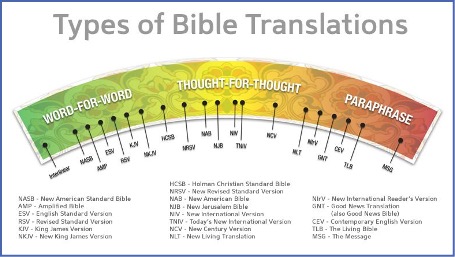
WE HAVE A CHART that will give you some sense of the Bible translation landscape.
Be grateful to Almighty God that He has made available so many different translations in English for believers, newcomers, scholars, and serious students alike!
The chart is printed below, but I’m going to describe it.
There are three basic classes of Bible translation: word-for-word, thought-for-thought, and paraphrase.
Word-for-word translations will provide the closest English equivalent to the original text word, be it in Hebrew, Aramaic, or Greek.
Thought-for-thought translations will give the English equivalent to a group of words forming a thought. In a sense, they smooth out the writing to make it more palatable to 21st century English-speaking ears.

The thought-for-thought translations cover a range from closer to word-for-word to closer to paraphrase, depending on the amount of license the translators used.
Paraphrase Bibles scrap the original writing and take a broad overview of the text. They might call their invention “holistic,” wherein they look at the “sense” of the passage as opposed to the actual wording.
Here is how our chart depicts the various translations:
- WORD-FOR-WORD: INTERLINEAR, NASB, AMP, ESV, RSV, KJV, NKJV.
- THOUGHT-FOR-THOUGHT: HCSB (CSB), NRSV, NAB, NJB, NIV, TNIV, NCV, NLT.
- PARAPHRASE: NirV, GNT (GNB), CEV, TLB, MSG.
Still confused? Don’t be. Hang in there.
HERE’S A SUGGESTION: Read the Bible. Pray to God. Spend time with the Holy Spirit. He will lead you where He wants you to go. Then go there.
For now, why not start with a reputable translation with wording that you can understand. As you delve deeper into Bible study, you’ll become more comfortable comparing versions.
Buy different translation Bibles or use one of the handy Bible apps for your phone or tablet that allow you to download multiple versions of the Bible in multiple languages. Use the split-screen option.
With a split-screen, you can read a word-for-word translation on the left side and a thought-for-thought or paraphrase version on the right side.
By reading them together, you’ll get a deeper sense of the original wording along with an easier-to-understand translation. The two together should help you draw closer to God as well as help you memorize various verses.
Experiment. Have fun! This is God’s Word you’re starting to discover. You’ll find that, if you’re serious about finding God, He’s more than equally serious about finding you.
How’s about this for encouragement: You will seek me and find me when you seek me with all your heart. – Jeremiah 29:13 (NIV)
Note that the wording is from the NIV that you’re so fond of. Experiment on your own to see how other translations compare.
Remember this promise: Draw near to God and He will draw near to you. – James 4:8 (NASB).
Okay, that was from the NASB. Check out where NASB is on the above chart. See where the NIV is and then read James 4:8 in your Bible.
Hey, ask one of those young ladies with the NCV or the GNT or even the man in the back with his KJV what their versions say. Ask them why they like those translations. Listen to them. Tell them your thoughts. Pray with them.
Together, all of you will be joining together on life’s greatest, most rewarding, journey!
Be a Berean!
Don’t know who the Bereans were? Check out Acts 17:11. Go ahead. Look it up. Yes, do it now. Try any translation. Try several!
You’ll be glad you did.
Then, once you’ve read that verse, be a Berean!
NARRATOR
WHAT DID YOU LEARN from that exchange between the Instructor and the Class? You saw 20 translations listed. There are more in English, including some I have used that are not listed, such as the BSB and the WEB. For those of you are fluent, or even semi-fluent, in a second language, you’ll have the advantage of adding more translations to compare.

A web search shows there are more than 450 versions of the Bible in the English language – with estimates of about 900 translations since the 16th century, when the printing press was invented. Most of those translations are no longer in print, having been updated or replaced. The exact number of translations depends on the definition one uses as to what constitutes a new translation versus a revision.
We know the various translations serve different purposes. Scholars and serious students will gravitate to the exact translations, while newer minds will find the easier-to-read options more inviting.
It looks like the instructor is ready to speak.
INSTRUCTOR
The word-for-word translations have the advantage of being truer to the original text being translated, so the accuracy rate is higher. In other words, we can say it is a “truer translation” to the original.
The disadvantage is that the writing often is stilted and can be more difficult for us to read and comprehend.
The thought-for-thought translations seek to rectify the comprehension difficulty of the word-for-word translations by rewriting the text, so it reads like your daily newspaper.
The advantage of comprehension is offset sometimes by slight-to-moderate deviations from the original writing, which can lead to a different interpretation of the text, so one needs to be careful when reading them.
The paraphrase options are the most suspect for serious Bible readers and scholars but often present the easiest-to-understand versions for the casual reader or new Christian.
As we can see, each style has its advantages and disadvantages, so I would recommend doing the following:
- EXPERIMENT. Check out various translations and find the one or ones you like. As far as I can tell, there is no wrong choice, just be diligent in reading your Bible.
- COMPARE. Read a side-by-side Bible, either in print or digital app version, so you will have a word-for-word translation side-by-side with a thought-for-thought version. That will give you the advantages of both – a truer translation plus an easier-to-read version. Compare both translations against a paraphrase to see if that helps you. It might or it might not. For paraphrases, I like the GNT and often use it in my writing, but I would not depend on it for my study or devotions.
The more comfortable you become reading your Bible, the easier it will be for you to identify the translation that fits you best, the one you turn to for your devotions and study.
NARRATOR – FINAL WORDS
I PREFER USING the New King James Version and the English Standard Version as side-by-side, but I also make heavy use of the Christian Standard Bible, Berean Standard Bible, and New International Version Bible.

In my Life Bible app, I have all five versions called up in two rows: In the top row, I have the NKJV and ESV side-by-side; in the bottom row, with skinnier columns, I have the CSB, BSB, and NIV side-by-side.
That gives me the range of translations I like while making it easier for me to read the NKJV with the ESV as a smoother version to read alongside it.
You’ll need to determine what system works best for you.
Remember: Keep reading your Bible!
PRAYER & BENEDICTION
ALMIGHTY GOD, LORD OF CREATION:
We are so grateful for the love You bestow on us.

You have given us a Bible that we can read and treasure, a book capturing the very words of Jesus Christ, the interpretative letters written by His closest followers, and the prophets and historians of the Old Testament, foretelling the Messiah.
Help these, Your faithful servants, as they go to their rooms for solitude and gather in groups for fellowship, to seek Your truth, Your Word, Your promises that, when followed, will enrich their lives and save their souls.
Whichever version or versions of Holy Writ they decide on, we pray Your encouragement for them to stay in the Word and not find daily excuses to avoid that very important Christian discipline.
As they do, O Lord, may Your Word continue to change their lives.
We lift this prayer in praise and thanksgiving. In Jesus’ name.
NOW, may the Lord bless you and keep you. May the Lord make His face shine on you and be gracious to you. May the Lord turn His face towards you and give you peace, both now and forevermore. AMEN and AMEN
 Ward's Words | BY WARD PIMLEY