
A CHRISTIAN MESSAGE
By WARD PIMLEY
Pastor, Journalist, Author
Part 1 is at HERE
Call to Worship
Psalm 150:1-6 NKJV
Praise the LORD!
Praise God in His sanctuary; Praise Him in His mighty firmament! Praise Him for His mighty acts; Praise Him according to His excellent greatness!
Praise Him with the sound of the trumpet; Praise Him with the lute and harp! Praise Him with the timbrel and dance; Praise Him with stringed instruments and flutes!
Praise Him with loud cymbals; Praise Him with clashing cymbals! Let everything that has breath praise the LORD.
Praise the LORD!
PREAMBLE
MERRY CHRISTMAS!
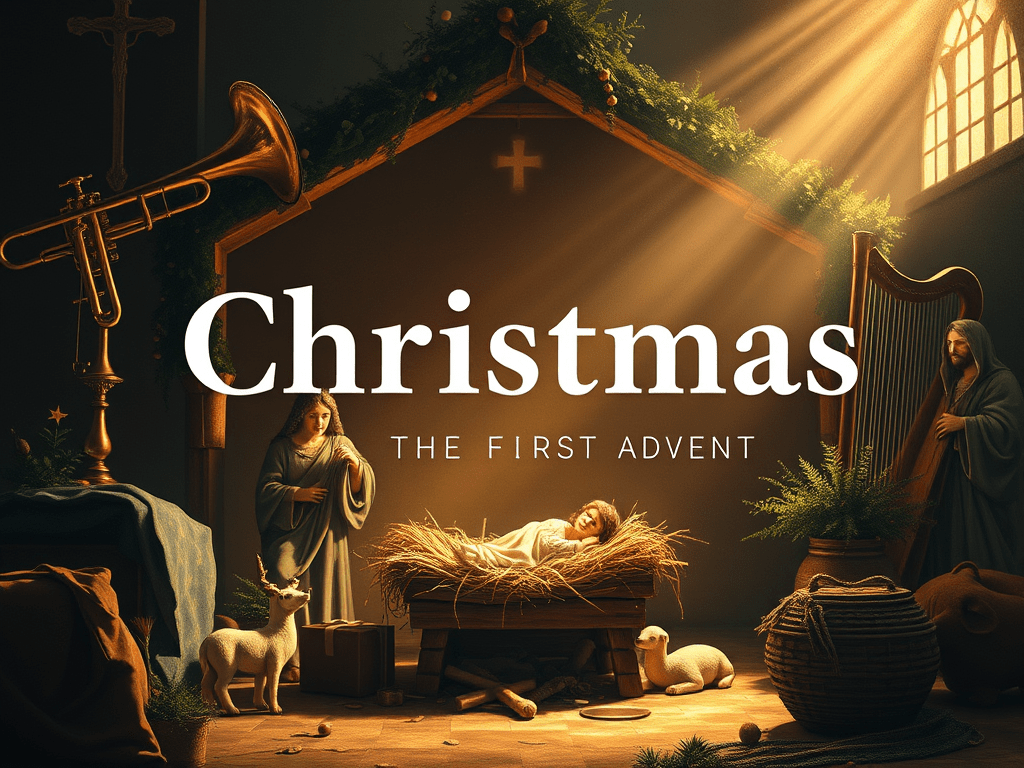
- Christmas is God’s promise to restore man’s fellowship with God, in loving response to man’s sin, fulfilled in Christ’s humble birth, which is “The First Advent.”
- This act of perfect obedience by our Lord Jesus points us to redemption in the present, and in the future His glorious return, which is “The Second Advent,” when He will reign forever.
- We make the point in this message that the world might love the Baby Jesus, “asleep in the manger, no crying He makes,” yet this Child grew up and changed the world, and if we keep Him in the manger, we miss the significance of His birth.
- His life was so consequential,
- He divided history into “before” and “after.”
- Countless lives have been saved, with more to come. [God knows the exact number, and He will send His Son to redeem the church when the full number of Gentiles will have come in.]
- His birth, and the celebration around it, is the single most riveting event that ties believers together around the world. Although His resurrection and ascension [ Easter and Pentecost] are more important theologically, His birth [Christmas] is what best captures our imaginations.
- No other life throughout history has had such an impact on the world. … but if we hold Him as a Child in the manger and do not acknowledge His ministry, His miracles, His teaching, His beating, and His death on the Cross, followed by His burial, His resurrection, and His ascension back into Heaven — unless we acknowledge all of that — we will have missed the whole point of Christmas — God’s promise of redemption.
This, then, is the First Advent or Coming of our Lord.
- Christ’s infanthood was merely the beginning.
- With that being said, let’s join in prayer and then go to the beginning …
OPENING PRAYER
ALMIGHTY GOD, Our Father and the World’s Creator, we invoke Your presence as we gather this Lord’s Day to praise Your Holy Name. Be with us and guide us, we pray, as we sing songs of praise and thanksgiving, as we open our hearts to prayer, as we hear a message based on passages from Your Word. Take away our discomfort and sorrows, our fears and pains, our disappointments and discouragements, we pray, and replace them with Your peace. As we come boldly before the Throne of Grace in obedience to Your Word … we raise this prayer in the Mighty Name of Jesus, the Christ, the Messiah. AMEN
PART 1. THE BEGINNING
“And I will put enmity Between you and the woman, And between your seed and her Seed; He shall bruise your head, And you shall bruise His heel.” – Genesis 3:15 NKJV
THE BEGINNING OF CHRISTMAS. God promised us a Messiah in Genesis 3 when Adam and Eve – our first parents – were still in the Garden of Eden.
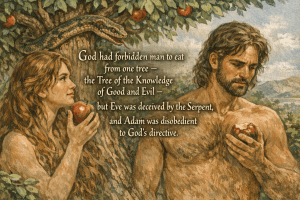
God had forbidden man to eat from one tree – the Tree of the Knowledge of Good and Evil – but Eve was deceived by the Serpent, and Adam was disobedient to God’s directive.
God placed a curse on the Serpent, on Eve, and on Adam. Then He kicked them out of the Garden. Why? Because He did not want them to eat from the Tree of Life, also in the Garden, and inherit eternal life in their fallen state.
He wanted to redeem them first. Seen on one hand as a punishment for their disobedience, the act also is an act of divine grace, setting Adam and Eve apart for redemption. So, the Protoevangelium. The First Gospel message. God told Satan that He would bruise the Messiah’s heel (crucifixion), but the Messiah would bruise his head.
- Genesis 3:16: “He shall bruise your head, And you shall bruise His heel.”
- Roman 16:20: “And the God of peace will crush Satan under your feet shortly.”
- Revelation 20:10: “The devil, who deceived them, was cast into the lake of fire and brimstone where the beast and the false prophet are. And they will be tormented day and night forever and ever.”
When we swing over to the New Testament and the familiar story of the Messiah’s birth found in Luke 2, we see the further humble sacrifice our Lord made in agreeing to come to earth as the atonement for our sins. Listen to this:
“Joseph also went up from Galilee, out of the city of Nazareth, into Judea, to the city of David, which is called Bethlehem, because he was of the house and lineage of David, to be registered with Mary, his betrothed wife, who was with child. So it was, that while they were there, the days were completed for her to be delivered. And she brought forth her firstborn Son, and wrapped Him in swaddling clothes, and laid Him in a manger, because there was no room for them in the inn.” – Luke 2:4-7 NKJV
Matthew and Luke recount the birth of Jesus, the Christ Child.
We learn a more detailed and robust reading of the event when we combine the two evangelists’ testimonies.
Whereas Matthew recounts the event as the fulfillment of Jewish prophecy – He was the Messiah, after all – Luke gives us a human presentation with Shepherds and Wise Men, with Mary and Joseph and Gabriel (God’s special messenger).
It’s always intrigued me that Mary and Joseph could not find lodging in Bethlehem, either among family or, as a last resort, one of the inns, given that hospitality was an accepted virtue in the Near East at that time.
Do you suppose it had anything to do with the shame of unmarried Mary’s obvious pregnancy?
Knock. Knock.
- “Nope, no room for you here, Son. Try the Inn.”
- “No, Sir, sorry, we’re all filled up. Try another Inn, the one down the street.”
- Nothing here, either, Sonny. Sorry.”
- “Last room was rented just yesterday … but wait. There’s a stable out back. You can shove the animals aside and use their feeding trough if you want. Whatever. Just be gone with you.”
Slam. Slam. Slam. One door after another. One judgmental voice after another. One cross look after another.
The humblest birth possible for the most august baby ever born. The Lord of lords and King of kings was born to redeem mankind, and mankind, even from the beginning, shut the door in His face.
We love to celebrate the Baby Jesus because “no crying He makes.” He’s harmless there. He’s not preaching to us there. He’s not challenging us there. He’s just a precious little baby wrapped in swaddling clothes and placed in a manger, no crib for His bed.
Still to come would be His growing up years, with the births of His half-siblings – four boys and several girls – His hanging out at the Temple at the age of 12, discoursing with the rabbis, holding their attention with His questions and His pronouncements. They were astonished with how much this young man knew about Scripture. (Well, He did write the book!)
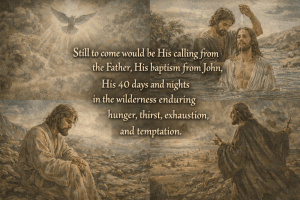
Still to come would be His calling from the Father, His baptism from John, His 40 days and nights in the wilderness enduring hunger, thirst, exhaustion, and temptation.
Still to come would be His calling of disciples – the First Apostles – who would walk with Him for three years and, all but one of them, carry on His ministry.
Still to come would be His coming out party at the Temple in Capernaum, where He told the congregation of His first Advent from a reading in Isaiah, when the reading stopped with a comma. … [More on that in Part 2]
And then the congregation tried to stone Him to death … because He stopped at the comma and sat down, proclaiming that He had come to fulfill that prophecy. The congregation knew only God could fulfill that prophecy, but they would not accept that this man was God.
Still to come would be the Sermon on the Mount, the most exquisite, insightful, erudite sermon ever given in which Jesus would:
- Provide salve for our wounds (“Blessed are the meek for they shall inherit the earth”),
- Challenge us to our mission (“You are salt and light to the world”), and
- Raise the bar on committing sin (“You have heard it said … but I tell you if you even think about it or call your brother a fool you will be judged guilty”).
STILL TO COME WOULD BE …
THREE YEARS OF WANDERING ABOUT, healing the sick and afflicted, teaching the Lord’s Good News message, contending with the Pharisees, scribes, and other Jewish leaders, overturning the merchants’ tables in the Temple’s courts (“My Father’s house shall be called a House of Prayer, but you have turned it into a den of thieves.” “Zeal for my father’s house will consume me.” – Isaiah 56:7; Psalm 69:9, Matthew 21:13; John 2:17). All prophesied in the Scriptures; all fulfilled by Jesus.
GIVING SIGHT TO A BLIND MAN, causing the deaf and mute to hear and speak, and leading a lame man to pick up his mat and skip and jump into the worship service.
RAISING A WIDOW’S SON FROM THE DEAD, healing a woman bleeding for 12 years, raising a 12-year-old girl from the dead, restoring a woman caught in adultery, revealing Himself as the Messiah to a Samaritan woman at the well, and curing Mary Magdalene of her many demons.
THE WOMEN. Did you notice how many of our Lord’s miracles were done to elevate, restore, and heal women?
- My sense of this is Jesus’ intent on showing the tenderness, love, protection, and respect that men are charged by God to show women, just as the women, in response to that protection and leading, are to respect their husbands.
- Is it any wonder, then, that women flocked to Jesus’ ministry and followed Him and His closest disciples, or that women of means helped cover His expenses?
- Even the first evangelist was Mary Magdalene, whose job it was to tell Peter, John, and the rest that she had seen the risen Christ. The Message of His resurrection was first entrusted to her.
STILL TO COME WAS … PASSION WEEK, with Jesus riding a mule into Jerusalem, knowing the week would end with His execution on the Cross, yet He did so for our sakes, and He did so willingly.
You see, the Protoevangelium from Genesis 3 pointed directly to this week. The serpent would bruise His heel, but the Messiah would bruise the serpent’s head. (Romans 16 says He would crush Satan’s head.) Satan would suffer defeat at the very moment he thought was his crowning victory.
Yes, we love to see the Baby Jesus lying in His mother’s arms, His father holding a staff and standing watch nearby, the cattle munching straw and hay, flooding the floor with waste.
As you focus on that Manger scene do you feel a sense of the humiliation, the mundaneness, the unspeakable commonness of this scene, of our introduction to Christmas? What a come down from the glories of His divinity in Heaven to His humanity lying in an animals’ feeding trough, dependent on an unmarried teenage mother and a shell-shocked father for His very survival.
Later, He would slog through the mud and muck of ancient Israel, basically wearing a bathrobe and bedroom slippers.
I would not want to exchange the comforts of my home and my life for that life; yet He willingly sacrificed comforts and joy that far exceed our imagination to live in the most trying of circumstances … and He did so willingly for us, with His heart filled with love for us.
Remember, the Bible says He saw the multitude and had “compassion” on them. (Matt. 9:36)
We love singing the Christmas Carols. Oh, they speak of such joy! Such happiness! Such peace! Such promise!
“Away in a manger, no crib for His bed; the little Lord Jesus laid down His sweet head.”
STILL TO COME WAS THE FUTURE, as we see the message of Christmas play out in human history, as the Christ Child grows into manhood and begins His three-year ministry – healing, exhorting, condemning, encouraging, coaxing — culminating in His crucifixion, death, burial, resurrection, and ascension back to Heaven.
STILL TO COME … but it started in the Manger.
This was Part 1 of a two-part series. Part 2, THE MEANING, is found here.
 Ward's Words | BY WARD PIMLEY