
This message addresses dangers of false teachers and doctrines within the church, based on biblical texts from two early Christian leaders: The Apostle Peter and Jude, a half-brother of Jesus. The chapters, 2 Peter 2 and Jude, highlight various types of false teachers and warns believers to remain vigilant and grounded in Scripture. They remind us that failure to stay close to the Lord in Scripture and Prayer will leave us vulnerable to falsehood. You cannot arm yourself against falsehood unless you ground yourself in God’s Word. There are no shortcuts. Salvation requires vigilance on all our parts. Be on guard!
A CHRISTIAN MESSAGE
By WARD PIMLEY
Pastor, Journalist, Author
“But false prophets also arose among the people, just as there will be false teachers among you, who will secretly bring in destructive heresies, even denying the Master who bought them, bringing upon themselves swift destruction.” – 2 Peter 2:1 ESV
“For certain people have crept in unnoticed who long ago were designated for this condemnation, ungodly people, who pervert the grace of our God into sensuality and deny our only Master and Lord, Jesus Christ.” – Jude 1:4 ESV
PREAMBLE
HERESY, OR FALSE TEACHING, has been a destructive element in the church from the very beginning. Once Jesus Christ returned to Heaven and the First Generation of Christians, led by the very Apostles who followed our Lord for three years, died off, the church was led by men who never walked physically with Jesus, never saw Him heal the sick or restore life to the physically and spiritually dead, nor saw Him walk the Earth following His crucifixion.

During this period and ever since, rival philosophies or theories were, and have been, expounded that the nascent church and its successors have had to defend against.
It has been far easier to advance false or distorted teaching once the Master and His closest followers were gone than when they were present and able to refute false teaching.
They warned us to be on guard.
Among those false teachings were that Jesus was not God but a man, just a prophet; that He had not existed from eternity past but was a created being, denying the existence of the Trinity; failure to recognize the Holy Spirit as a Person but considering Him an ‘It’; that man was not born with a sin nature but developed his own propensity for sin; and that Jesus was not fully God and fully man at the same time.
Additionally, disputes within the church have developed that have broken a unified voice.
One dispute focused on whether salvation was extended only to those whose salvation was pre-destined or pre-selected by God or whether salvation was based on God’s grace and an individual decision in response to the exercise of free will; whether there was double predestination, which included the doctrine of reprobation, where God predetermined who would face an eternity in condemnation and punishment, or whether that punishment also was the result of free will, based on a rejection of God’s calling.
As time went on and controversies were settled, new conflicts arose. The reason for this is simple: Satan was, and is, at work, striving to disrupt God’s plan for salvation and reconciliation.
Whole congregations within the Protestant realm have split over doctrinal disputes, with the more conservative wing holding fast to a literal interpretation of the Bible while the progressive wing divorces itself from literal interpretation in favor of a “living” or evolving interpretation more in keeping with the secular culture.
The Roman Catholic Church faces its controversies separately, teaching that Church doctrine supersedes biblical teaching. That false holding has led its leaders to advance different teachings throughout the ages under the guise of “new revelation.”
That failure to follow Holy Script has led to power struggles within church leadership and faulty teaching like the selling of indulgences and the teaching that faith alone is not sufficient for salvation, even though the Bible says it is.
By the way, Protestant reformers who took issue with the Catholic Church’s teaching fared no better. While they denied that the Catholic Church supplanted Israel, they taught that the Protestant reformed churches were the actual successors to Israel. That also is a false teaching.
It also has led to a highly destructive false teaching that Christianity has replaced Israel and the Jews as God’s favored people. That is not true. The Bible teaches that God’s plan for the Jewish people will come to pass in the Millennium.

That false teaching is called “replacement theology,” and it denies the Bible’s clear teaching that God is not done with Israel but that He will fulfill every promise He has made to the Jewish people.
In Peter’s second letter, he only makes general references to specific sins so he can urge his listeners (readers) to focus more on the idea of false teaching than on specific ones. Nevertheless, he does point out (a) denying the deity of Jesus, (b) the right to indulge in sexual sin without consequence, and (c) telling lies for personal gain.
Let’s take a look at false teaching and doctrine so we can guard ourselves against its destructive force.
FALSE TEACHERS: SEVEN TYPES
WHILE SATAN HAS SOUGHT to divide the church by attacking it from outside, its most destructive falsehoods have arisen from within, notably when pastors, theologians, and teachers either add words to the Scripture or delete words from it.
The result is a distortion of the Bible’s truth, and not surprisingly, the Bible, in both the Old and New testaments, warns us against doing either.
By way of reminder: To list a variety of false teachers requires us to split into distinct categories descriptions that often overlap and combine with other categories. We should not make the mistake of thinking any individual falls exclusively within one category to the exclusion of others.
THE HERETIC
THE HERETIC teaches as doctrinal truth an idea that one commentator said “blatantly contradicts” a core teaching of Christianity. Heretics usually are gregarious, charismatic figures who lead their flock as though they, themselves, were the Savior.
This category is like the Prophet, except it focuses on false doctrine as opposed to the teacher’s persona.
Our text sources today from 2 Peter 2:1 and Jude 1:4 speak directly to this evil, as both church leaders warned successive generations to be on the look-out for false teachers, who would invade the church and lead the vulnerable astray.
Modern theologians, following a school of skepticism, distort Jesus’ teaching, often because they themselves do not believe in the supernatural. Jehovah’s Witnesses alter the text so that Jesus becomes “a” god as opposed to “the” God, and Mormons add to the Gospel the Book of Mormon, which is not biblical.
The Heretic is the teacher who violates Jude 1:3 ESV, “Beloved, although I was very eager to write to you about our common salvation, I found it necessary to write appealing to you to contend for the faith that was once for all delivered to the saints.”
THE CHARLATAN
THE CHARLATAN uses his position of privilege to enrich himself, urging the faithful to contribute their tithes and offerings to his personal ministry.
Through the ages, this has ranged from the selling of indulgences by the Roman Catholic Church, the profits of which funded construction of St. Peter’s Basilica in Rome, underwrote the pope’s lavish lifestyle, and underwrote some of the world’s most cherished artwork, including that by Michelangelo and Raphael.
That is not an endorsement of the practice of indulgences; only it goes to show the magnitude of the false teaching.
Today, we see television evangelists – called “televangelists” – who use their outsized personas and smooth words to bilk the faithful into sending in contributions ostensibly to grow the ministry but, in reality, grow the speaker’s wealth.
Some have built notable cathedrals as monuments to themselves or drive around in luxury automobiles, all while telling the congregation that they, too, can have their “best life” if they remain faithful to the charlatan’s teaching.
The Apostle Paul was having none of it when he wrote to his disciple Timothy in 1 Timothy 6:3-5 GW:
“Whoever teaches false doctrine and doesn’t agree with the accurate words of our Lord Jesus Christ and godly teachings is a conceited person. He shows that he doesn’t understand anything. Rather, he has an unhealthy desire to argue and quarrel about words. This produces jealousy, rivalry, cursing, suspicion,and conflict between people whose corrupt minds have been robbed of the truth. They think that a godly life is a way to make a profit.”
THE PROPHET
THE PROPHET is the leader who purposefully sets himself up as a voice from God, which is intentional, while in other cases develops over time from the sin of human pride. This is the situation where one’s success in building a church or ministry is attributed not to the workings of the Holy Spirit but to the dedication of the teacher or leader.
The prophet traffics in words of encouragement, prophecy, or rebuke that stem from his own imagination as opposed to God’s actual teaching. Many teachers today claim to be speaking in God’s name when there is no connection between God’s will and the prophet’s mouth.
Their falsehood can be readily discerned by anyone familiar with God’s Word, so they naturally prey upon the gullible – individuals looking for answers to life’s questions who do not know what the Bible teaches and so are more likely to believe falsehood.
Those who are reading their Bibles faithfully are better able to see through the charades, knowing they have been warned, not only by the Apostle Peter and Jude, the Lord’s half-brother, but also by the Apostle John and the Apostle Paul.
Here’s John, “Beloved, do not believe every spirit, but test the spirits to see whether they are from God, because many false prophets have gone out into the world.” 1 John 4:1 NASB
Here’s Paul, “God, by his grace through Christ, called you to become his people. So, I am amazed that you are turning away so quickly and believing something different than the Good News. Really, there is no other Good News. But some people are confusing you; they want to change the Good News of Christ.” Galatians 1:6-7 NCV
THE ABUSER
THE ABUSER uses his position of authority to take advantage of other people. This sin takes place in all Christian churches, both with Catholic priests and Protestant ministers.
They use their position in the religious institutions to cover the evil in their hearts.

Much of their evil is focused on sexual lust, where the church leader preys on troubled girls looking for guidance from a solid father figure or young boys uncertain about their own sexuality.
The abuser claims he is tending to the souls of the flock, especially of the weakest and most vulnerable members, but his (or her) true interest is in gaining illicit sexual liaisons, or adding to their personal bank account, or gaining power and influence.
Throughout the ages, the church has been infected with abusers. In its earliest days, the faithful followed the sexual perversions of the pagans around them; the papacy was a battleground of political struggle, and even today, Christian icons are felled by sexual and moral failings. So many examples abound, and the secular press is always eager to pounce on any rumor of waywardness.
One woman sadly told me years ago, “My ex-husband graduated from seminary and still had an affair, which ended our marriage.” In her confusion, she asked, “How can that be?”
Peter, in 2 Peter 2 NLT says, “Many will follow their evil teaching and shameful immorality. And because of these teachers, the way of truth will be slandered.”
Jude says this in Jude 1:4 CSB: “For some people, who were designated for this judgment long ago, have come in by stealth; they are ungodly, turning the grace of our God into sensuality and denying Jesus Christ, our only Master and Lord.”
THE DIVIDER
THE DIVIDER uses false doctrine to divide a church, separating brothers and sisters of faith into warring parties.
There always will be disagreement within the church body, just as there is disagreement within households, but the divider, as described here, is not just someone who sees things differently than the church leader but someone who hungers for the attention that being a spoiler brings.
This person can ride a minor doctrinal or practice dispute into a major rift, forcing factions within the church to choose sides.
Their sole purpose is to feed the satisfaction they receive by seeing others suffer.
Jude warned against this abuse this way (Jude 1:18-19 NIV), “In the last times there will be scoffers who will follow their own ungodly desires. These are the people who divide you, who follow mere natural instincts and do not have the Spirit.”
THE TICKLER
THE TICKLER is the teacher who tells the flock what they want to hear. This is the man-pleaser, the one who sacrifices the hard sayings of the Bible into story time and feeds the egos of church members, eager to “feel good” about themselves.
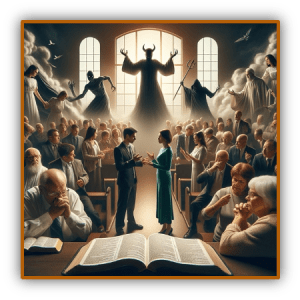
The tickler’s driving force is the desire for fame and popularity, to be “liked” by many. Sometimes, the tickler is driven by a desire to build the church into a large, profitable organization that drips with money and prestige.
Regardless of church size, the Tickler’s weekly message evokes happiness among the flock, as opposed to salvation. There is a reason our Lord came to Earth from Heaven to die on a Cross, but that reason is our sin, and who wants to hear about sin? Especially not when the reason comes at the expense of a good joke.
After all, the church attendees are less interested in praising God because they would rather praise themselves and feel “good” about themselves.
In 2 Timothy 2:3-4 BSB, Paul says, “For the time will come when men will not tolerate sound doctrine, but with itching ears they will gather around themselves teachers to suit their own desires. So, they will turn their ears away from the truth and turn aside to myths.”
These are the false voices who echo Jeremiah’s cry in 6:4 NKJV, “They have also healed the hurt of My people slightly, Saying, ‘Peace, peace!’ When there is no peace.”
THE SPECULATOR
THE SPECULATOR wants to be original or spectacular in some way, not for Godly gain but for its own sake.
This is a false prophet who is a consummate entertainer, eager to spout the latest nonsense regarding the “last days” or “end times” and giving, perhaps, his own interpretation of what the current world landscape portends.
This is not to be confused with “end times” prophecy, which is based on biblical teaching but is mere speculation based on the Speculator’s own imagination.
These are the people who rake in millions of dollars from those who want to read their prognostications on when the world will end. The world will end, but God has not seen fit to tell us when.
Teaching focused on speculation displaces the sure and steady doctrine of Scripture. The Speculator tosses aside the bulk of the Bible’s content and the weight of the Bible’s emphasis to obsess about matters that are trivial or novel. He grows weary of the old truths and pursues respectability through originality.
In God’s eyes, the Speculator is neither respected nor original. He’s just plain wrong.
Sometimes he plants himself in academia, where one of his recent masterpieces is a re-imagined God who is unable to see and know the future. Well did Paul label the Speculator a contradictory, irreverent babbler.
Haven’t we been told in multiple books of the canon not to dabble in false teaching?
Here are some reminders:
- “Do not be carried about with various and strange doctrines.” Hebrews 13:9a NKJV
- “I asked you to stay longer in Ephesus when I went into Macedonia so you could command some people there to stop teaching false things.” 1 Timothy1:3b NCV
- “But as for you, speak the things which are proper for sound doctrine.” Titus 2:1 NKJV
- “Timothy, guard what God has trusted to you. Stay away from foolish, useless talk and from the arguments of what is falsely called “knowledge.” By saying they have that “knowledge,” some have missed the true faith. Grace be with you.” 1 Timothy 6:20-21 NCV
CONCLUSION
THESE DESIGNATIONS were provided in a 2017 article from Pastor Tim Challies, a Canadian speaker and author [Pastor Tim Challies].
While these are overview snippets of a wider and deeper treatment in various books he has written and speeches he has given, each highlights a portion of the evil against which we should be vigilant [7 False Teachers in the Church Today, Jan. 31, 2017, Pastor Tim Challies.]
Separating the whole into segments is much like looking at each individual color in the rainbow, when, in reality, we are unlikely to see one false teacher as the color “red,” another one as “blue,” and so one. Instead, they will be a blend of several categories, although it is possible to point out one or two characteristics that seem to define this one or that one more specifically.
The point of this is that Satan’s greatest weapons are not necessarily the secularists outside the church attacking Christianity or decrying the power of “thoughts and prayers” or naming believers as “bigots,” “haters,” and “intolerant,” or even the academics discounting the possibility of supernatural intervention in human life.
No, the greatest danger to the churches may well come from within the church, from its leaders – its pastors, theologians, and teachers – the very people we should be trusting to deliver the truth to us, to lead us and guide us according to God’s eternal plan.
Pastor Tim describes Satan’s tactics as being “studied, clever, predictable, [and] effective.” “Studied” means Satan watches us carefully; “Clever” means he is tricky; “Predictable” means he uses the same tactics over again; and “Effective” means, well, they work.
False teaching, like weeds, sprouted up as soon as the Church Age began, and false teaching, like weeds, have been growing splendidly for 2,000 years and more. They follow the falsehoods perpetrated in the Old Testament by false prophets.
We, the church, must not be cowed by false teaching, but we must stand on guard against it and fight back. We do that by being grounded in the Word of God.
Church, if you do not ground yourself in God’s Word, you will remain vulnerable to the power and deception of false teaching.
Jesus warned us in His Sermon on the Mount, Matthew 7:15-16a NKJV, “Beware of false prophets, who come to you in sheep’s clothing, but inwardly they are ravenous wolves. You will know them by their fruits.”
FINAL WORDS
WHEN WE DISCUSS the topic of “false teaching” or “false doctrine,” we need to be careful in how we approach it.
One reason is that, apart from those core doctrinal points that our God has made crystal clear, much of church doctrine is subject to interpretation, and one person’s interpretation can differ from another person’s interpretation without either of them being entirely right or entirely wrong.
Here are some doctrinal beliefs that are without conflict: Jesus was both God and man, Jesus was born of a virgin woman, Jesus was crucified for our sins, Jesus was raised from the dead, and Jesus now sits at the Father’s side in Heaven. To be saved, the Bible says, we need to believe those points and receive the Holy Spirit into our hearts.
Many other teachings — such as the nature of the elements in Communion, the actual naming of Communion, whether children can be baptized into the faith or whether baptism is reserved for those who believe, whether the act of baptism itself has salvation power or whether it is only an outward symbol of an inner transformation — are not core doctrines. We can dispute another’s opinion, but they are not central to our salvation.
There are three teachings in particular today that are causing a rift in Christendom, with fissures and fractures causing denominations to splinter and factions to grow within denominations even without a formal separation.
They are:
- Homosexuality, transgenderism, and same-sex marriage.
- Illegal immigration, asylum, open borders, and controlled migration.
- Women’s role in the church, whether it should be driven by “egalitarian” or “complementarian” principles. (Each teaches the equality of women and men, but one says God created the sexes differently for complementary roles while the other says the two sexes are interchangeable, with the only exceptions being the ones related to reproduction.)
What this pulpit can say is that you, the faithful believer, must do your due diligence. You must continue to read your Bible, stay faithful in prayer, and ask God to continue to do what He wants to do anyway, which is this: Lead you.
- “Trust in the LORD with all your heart, And lean not on your own understanding; In all your ways acknowledge Him, And He shall direct your paths.” – Proverbs 3:5-6 NKJV
- “Then you will know the truth, and the truth will make you free.” – John 8:32 NCV
- “Do not be conformed to this world, but be transformed by the renewal of your mind, that by testing you may discern what its the will of God, what is good and acceptable and perfect.” – Romans 12:2 ESV
To remain faithful to His will, we need to remain faithful in our devotions – that is, reading our Bibles (or listening to the Bible read to us), praying to God, and asking Him to teach us His will for our lives.
My friends, let us resolve not to give in to the heretics, charlatans, false prophets, abusers, ticklers, dividers, and speculators among us. Let us remain faithful to God’s will.
If you do that, you will be blessed. That’s God’s promise, and that definitely is not false teaching.
BENEDICTION PRAYER
LORD, You have warned us to be on guard against those agents of Satan who would poison the church and our minds with false doctrine, aiming to mislead us and drive a wedge between believers and God, and aiming to split the church into warring factions, competing for attention, adherents, and resources.
Thank You for Your warning so we will be on guard against falsehood. Give us the desire, Lord, to read Your Word daily, to engage in prayer daily, and to strive daily to live according to Your plan for us. Forgive us, please, when we fail You. For those among us who may not know You in a personal way, may this be the moment that all changes.
Hear our prayer when we say: Lord, I am a sinner in need of Your forgiveness. I believe Jesus is Your Son and that He died on the Cross for my sins and that all who believe in Him and call on His name will be saved. Come into my heart, O Lord, and redeem me. Be my Savior and my Lord.
Lord, for those who do know You, we rgive thanks for the sacrifice of Your Son on our behalf. Give us the leading and the strength to be a living witness for what God has done for us that all may hear the Truth and give God the glory.
Now may the Lord bless you and keep you; may the Lord make His face shine upon you and be gracious to you. May the Lord lift up His countenance upon you and give you peace … both now and forevermore. Guide us and direct us, Lord, as we enter our mission field. AMEN and AMEN
 Ward's Words | BY WARD PIMLEY